Ch. 40 - Basic Principles of Animal Form and Function
Campbell - Campbell Biology 11th Edition
Urry11th EditionCampbell BiologyISBN: 9789357423311Not the one you use?Change textbook
Chapter 40, Problem 8

Draw a model of the control circuit(s) required for driving an automobile at a fairly constant speed over a hilly road. Indicate each feature that represents a sensor, stimulus, or response.

Verified step by step guidance
1
Identify the main components of the control circuit for maintaining constant speed: the driver, the car's speedometer, the engine, and the car's accelerator pedal.
Determine the role of each component: the speedometer acts as a sensor, the driver acts as the controller, the engine is the effector, and the accelerator pedal is the interface between the driver and the engine.
Illustrate the feedback loop: the speedometer measures the car's speed and sends this information to the driver (sensor to controller).
Show the driver's response: based on the speedometer reading, the driver adjusts the pressure on the accelerator pedal to maintain constant speed (controller to effector).
Indicate the stimulus-response relationship: changes in road incline (stimulus) affect the car's speed, prompting the driver to adjust the accelerator (response) to maintain constant speed.

Verified video answer for a similar problem:

This video solution was recommended by our tutors as helpful for the problem above.
Video duration:
2m
Was this helpful?

Key Concepts

Here are the essential concepts you must grasp in order to answer the question correctly.

Feedback Control Systems

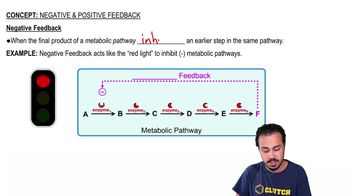
Feedback control systems are used to maintain a desired output by comparing it with the actual output and making necessary adjustments. In the context of driving a car at a constant speed, the system would adjust the throttle based on the difference between the desired speed and the actual speed, compensating for changes in terrain such as hills.
Recommended video:
Guided course
02:41
Negative Feedback

Sensors in Control Systems

Sensors are devices that detect changes in the environment and send this information to the control system. In an automobile, speed sensors measure the vehicle's current speed, providing data that the control system uses to maintain a constant speed by adjusting the throttle or brakes as needed.
Recommended video:
Guided course
09:19
Immune System

Stimulus-Response Mechanism

The stimulus-response mechanism involves detecting a change (stimulus) and producing a reaction (response) to maintain homeostasis. In driving, the stimulus could be a change in speed due to a hill, and the response would be the car's control system adjusting the throttle to maintain constant speed, ensuring smooth driving over varying terrains.
Recommended video:
Guided course
03:06
Inflammatory Response