
Pearson+ LogoPearson+ Logo
Ch. 40 - Basic Principles of Animal Form and Function
Campbell - Campbell Biology 11th Edition
Urry11th EditionCampbell BiologyISBN: 9789357423311Not the one you use?Change textbook
Chapter 40, Problem 1

The body tissue that consists largely of material located outside of cells is
a. Epithelial tissue
b. Connective tissue
c. Muscle tissue
d. Nervous tissue

Verified step by step guidance
1
Begin by understanding the characteristics of each type of tissue mentioned in the options. Epithelial tissue primarily consists of tightly packed cells with minimal extracellular material.
Consider connective tissue, which is known for having a large amount of extracellular matrix. This matrix is composed of fibers and ground substance, providing structural and biochemical support to the surrounding cells.
Muscle tissue is characterized by cells that are specialized for contraction, with very little extracellular material present.
Nervous tissue consists of neurons and supporting cells, with the primary focus on transmitting signals rather than having a large extracellular matrix.
Based on the descriptions, identify which tissue type is known for having a significant amount of material located outside of the cells, which is characteristic of connective tissue.

Verified video answer for a similar problem:

This video solution was recommended by our tutors as helpful for the problem above.
Video duration:
2m
Was this helpful?

Key Concepts

Here are the essential concepts you must grasp in order to answer the question correctly.

Connective Tissue

Connective tissue is a type of body tissue that provides support and structure to other tissues and organs. It is characterized by a large amount of extracellular matrix, which is the material located outside of cells. This matrix can include fibers like collagen and elastin, and ground substance, which helps in binding tissues together and providing structural integrity.
Recommended video:
Guided course
06:20
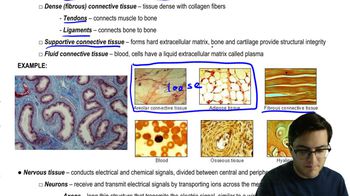
Connective and Nervous Tissues

Extracellular Matrix

The extracellular matrix (ECM) is a complex network of proteins and carbohydrates that surrounds and supports cells within tissues. In connective tissue, the ECM is particularly abundant and plays a crucial role in providing structural support, segregating tissues, and regulating intercellular communication. It is composed of fibrous proteins such as collagen, elastin, and glycoproteins, which contribute to the tissue's mechanical properties.
Recommended video:
Guided course
02:28
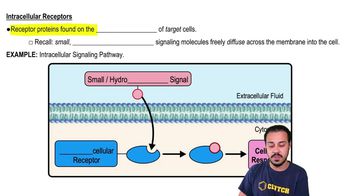
Intracellular Receptors

Types of Body Tissues

The human body is composed of four primary types of tissues: epithelial, connective, muscle, and nervous tissue. Each type has distinct functions and characteristics. Epithelial tissue covers body surfaces and lines cavities, connective tissue supports and binds other tissues, muscle tissue is responsible for movement, and nervous tissue transmits signals throughout the body. Understanding these differences is essential for identifying the tissue type in question.
Recommended video:
Guided course
06:58
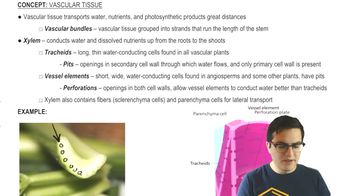
Vascular Tissue