Pearson+ LogoPearson+ Logo
Ch. 46 - Animal Reproduction
Campbell - Campbell Biology 11th Edition
Urry11th EditionCampbell BiologyISBN: 9789357423311Not the one you use?Change textbook
Chapter 46, Problem 8

Which statement about human reproduction is false?
a. Fertilization occurs in the oviduct.
b. Spermatogenesis and oogenesis require different temperatures.
c. An oocyte completes meiosis after a sperm penetrates it.
d. The earliest stages of spermatogenesis occur closest to the lumen of the seminiferous tubules.

Verified step by step guidance
1
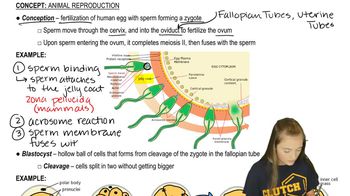
Understand the process of fertilization: Fertilization in humans typically occurs in the oviduct, also known as the fallopian tube. This is where the sperm meets the oocyte (egg) after ovulation.
Review the temperature requirements for gametogenesis: Spermatogenesis (sperm production) occurs in the testes, which are located outside the body to maintain a temperature slightly lower than the body's core temperature. Oogenesis (egg production) occurs in the ovaries, which are inside the body and do not require a lower temperature.
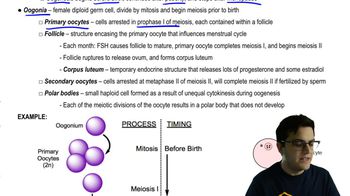
Examine the process of meiosis in oocytes: In human females, oocytes are arrested in metaphase II of meiosis and only complete meiosis upon fertilization, when a sperm penetrates the oocyte.
Understand the structure of seminiferous tubules: Spermatogenesis occurs in the seminiferous tubules of the testes. The earliest stages of spermatogenesis, such as spermatogonia, are located at the periphery of the tubules, not closest to the lumen.
Identify the false statement: Based on the understanding of the above processes, determine which statement does not accurately describe human reproduction.

Verified video answer for a similar problem:

This video solution was recommended by our tutors as helpful for the problem above.
Video duration:
2m
Was this helpful?

Key Concepts

Here are the essential concepts you must grasp in order to answer the question correctly.

Fertilization in the Oviduct

In human reproduction, fertilization typically occurs in the oviduct, also known as the fallopian tube. This is where the sperm meets the oocyte (egg) after ovulation. The oviduct provides the necessary environment for the sperm to penetrate the oocyte, leading to the formation of a zygote, which will then travel to the uterus for implantation.
Recommended video:
Guided course
11:44
Fertilization and Implantation

Spermatogenesis and Oogenesis

Spermatogenesis and oogenesis are the processes of forming male and female gametes, respectively. Spermatogenesis occurs in the testes and requires a slightly lower temperature than the body's core temperature, which is why the testes are located outside the body. Oogenesis occurs in the ovaries and does not have the same temperature requirement, as it takes place within the body's core temperature.
Recommended video:

Stages of Spermatogenesis

Spermatogenesis occurs in the seminiferous tubules of the testes, where sperm cells develop from germ cells. The process begins at the outer edge of the tubule and progresses inward toward the lumen. The earliest stages of spermatogenesis, involving spermatogonia, occur at the periphery, not closest to the lumen, which is where mature spermatozoa are released.
Recommended video:
Guided course
03:16
Stages of Photosynthesis