Pearson+ LogoPearson+ Logo
Ch. 5 - The Structure and Function of Large Biological Molecules
Campbell - Campbell Biology 11th Edition
Urry11th EditionCampbell BiologyISBN: 9789357423311Not the one you use?Change textbook
Chapter 5, Problem 9

Copy the polynucleotide strand in Figure 5.23a and label the bases G, T, C, and T, starting from the 5′ end. Assuming this is a DNA polynucleotide, now draw the complementary strand, using the same symbols for phosphates (circles), sugars (pentagons), and bases. Label the bases. Draw arrows showing the 5'→3' direction of each strand. Use the arrows to make sure the second strand is antiparallel to the first.
Hint: After you draw the first strand vertically, turn the paper upside down; it is easier to draw the second strand from the 5′ toward the 3′ direction as you go from top to bottom.

Verified step by step guidance
1
Start by drawing the first polynucleotide strand vertically. Use circles to represent phosphate groups and pentagons for sugar molecules. Label the bases in the sequence G, T, C, and T, starting from the 5' end at the top.
To draw the complementary strand, remember that DNA strands are antiparallel. This means the complementary strand will run in the opposite direction, from 3' to 5'.
For the complementary strand, use the base pairing rules: Guanine (G) pairs with Cytosine (C), Thymine (T) pairs with Adenine (A), Cytosine (C) pairs with Guanine (G), and Thymine (T) pairs with Adenine (A).
Draw the complementary strand using the same symbols: circles for phosphates and pentagons for sugars. Label the bases according to the pairing rules, starting from the 3' end at the top.
Finally, draw arrows to indicate the direction of each strand. The first strand should have an arrow pointing from 5' to 3', and the complementary strand should have an arrow pointing from 3' to 5'. Ensure the strands are antiparallel by checking the direction of the arrows.

Verified video answer for a similar problem:

This video solution was recommended by our tutors as helpful for the problem above.
Video duration:
41s
Was this helpful?

Key Concepts

Here are the essential concepts you must grasp in order to answer the question correctly.

DNA Structure

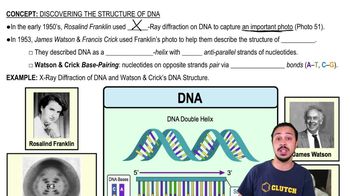
DNA is composed of two polynucleotide strands that form a double helix. Each strand consists of a sugar-phosphate backbone with nitrogenous bases attached. The bases pair specifically: adenine (A) with thymine (T), and cytosine (C) with guanine (G). Understanding this structure is crucial for drawing and labeling the strands correctly.
Recommended video:
Guided course
04:41
Discovering the Structure of DNA

Complementary Base Pairing

Complementary base pairing is the principle that dictates how bases pair across the two strands of DNA. Adenine pairs with thymine, and cytosine pairs with guanine. This concept is essential for drawing the complementary strand, ensuring each base on one strand is matched with its pair on the opposite strand.
Recommended video:

Antiparallel Orientation

DNA strands run in opposite directions, known as antiparallel orientation. One strand runs from 5' to 3', while the complementary strand runs from 3' to 5'. This orientation is crucial for accurately depicting the directionality of each strand, as indicated by arrows, ensuring the strands are correctly aligned.
Recommended video:
Guided course
04:41
Discovering the Structure of DNA