Pearson+ LogoPearson+ Logo
Ch. 5 - The Structure and Function of Large Biological Molecules
Campbell - Campbell Biology 11th Edition
Urry11th EditionCampbell BiologyISBN: 9789357423311Not the one you use?Change textbook
Chapter 5, Problem 6

The molecular formula for glucose is C6H12O6. What would be the molecular formula for a polymer made by linking ten glucose molecules together by dehydration reactions?
a. C60H120O60
b. C60H102O51
c. C60H100O50
d. C60H111O51

Verified step by step guidance
1
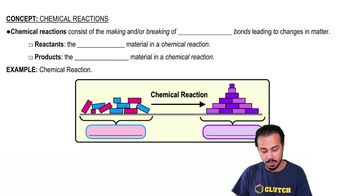
Understand that dehydration reactions involve the removal of water (H2O) molecules when forming polymers from monomers.
Calculate the number of water molecules removed: For each linkage between two glucose molecules, one water molecule is removed. Therefore, linking ten glucose molecules involves nine dehydration reactions, removing nine water molecules.
Determine the molecular formula of the polymer: Start with the molecular formula for ten glucose molecules, which is C60H120O60.
Subtract the atoms from the removed water molecules: Since nine water molecules (H2O) are removed, subtract 18 hydrogen atoms and 9 oxygen atoms from the initial formula.
Write the new molecular formula: After accounting for the removed water molecules, the molecular formula becomes C60H102O51.

Verified video answer for a similar problem:

This video solution was recommended by our tutors as helpful for the problem above.
Video duration:
55s
Was this helpful?

Key Concepts

Here are the essential concepts you must grasp in order to answer the question correctly.

Dehydration Reaction

A dehydration reaction is a chemical process where water molecules are removed to link monomers together, forming polymers. In the context of glucose, each dehydration reaction removes one water molecule (H2O) for each bond formed between glucose units. This is crucial for calculating the molecular formula of the resulting polymer.
Recommended video:
Guided course
01:56
Chemical Reactions

Glucose Structure

Glucose is a simple sugar with the molecular formula C6H12O6. It serves as a monomer in forming polysaccharides. Understanding its structure is essential because it helps in determining how the molecular formula changes when glucose molecules are linked together through dehydration reactions.
Recommended video:
Guided course
06:20
Glucose's Impact on Lac Operon Example 1

Polymerization of Glucose

Polymerization involves linking multiple glucose molecules to form a larger carbohydrate, such as starch or cellulose. When ten glucose molecules are linked, nine water molecules are removed (one for each bond), altering the overall molecular formula. This concept is key to solving the problem of determining the polymer's molecular formula.
Recommended video:
Guided course
06:20
Glucose's Impact on Lac Operon Example 1
Related Practice
Textbook Question

Which of the following is true of unsaturated fats?

a. They are more common in animals than in plants.

b. They have double bonds in their fatty acid chains.

c. They generally solidify at room temperature.

d. They contain more hydrogen than do saturated fats having the same number of carbon atoms.

4158
views
Textbook Question

The structural level of a protein least affected by a disruption in hydrogen bonding is the

a. Primary level.

b. Secondary level.

c. Tertiary level.

d. Quaternary level.

2666
views
Textbook Question

Enzymes that break down DNA catalyze the hydrolysis of the covalent bonds that join nucleotides together. What would happen to DNA molecules treated with these enzymes?

a. The two strands of the double helix would separate.

b. The phosphodiester linkages of the polynucleotide backbone would be broken.

c. The pyrimidines would be separated from the deoxyribose sugars.

d. All bases would be separated from the deoxyribose sugars.

3284
views
Textbook Question

Which of the following pairs of base sequences could form a short stretch of a normal double helix of DNA?

a. 5′-AGCT-3′ with 5′-TCGA-3′

b. 5′-GCGC-3′ with 5′-TATA-3′

c. 5′-ATGC-3′ with 5′-GCAT-3′

d. All of these pairs are correct.

3360
views
Textbook Question

Construct a table that organizes the following terms, and label the columns and rows.

Monosaccharides

Fatty acids

Amino acids

Nucleotides

Polypeptides

Triacylglycerols

Polynucleotides

Polysaccharides

Phosphodiester linkages

Peptide bonds

Glycosidic linkages

Ester linkages

1272
views
Textbook Question

Copy the polynucleotide strand in Figure 5.23a and label the bases G, T, C, and T, starting from the 5′ end. Assuming this is a DNA polynucleotide, now draw the complementary strand, using the same symbols for phosphates (circles), sugars (pentagons), and bases. Label the bases. Draw arrows showing the 5'→3' direction of each strand. Use the arrows to make sure the second strand is antiparallel to the first.

Hint: After you draw the first strand vertically, turn the paper upside down; it is easier to draw the second strand from the 5′ toward the 3′ direction as you go from top to bottom.

1504
views