

Pearson+ LogoPearson+ Logo
Ch. 50 - Sensory and Motor Mechanisms
Campbell - Campbell Biology 11th Edition
Urry11th EditionCampbell BiologyISBN: 9789357423311Not the one you use?Change textbook
Chapter 50, Problem 5

The transduction of sound waves into action potentials occurs
a. In the tectorial membrane as it is stimulated by hair cells
b. When hair cells are bent against the tectorial membrane, causing them to depolarize and release neurotransmitter that stimulates sensory neurons
c. As the basilar membrane vibrates at different frequencies in response to the varying volume of sounds
d. Within the middle ear as the vibrations are amplified by the malleus, incus, and stapes

Verified step by step guidance
1
Understand the process of sound transduction in the ear, which involves converting sound waves into electrical signals that the brain can interpret.
Recognize that the cochlea in the inner ear is the primary site where sound transduction occurs, involving structures such as the basilar membrane, tectorial membrane, and hair cells.
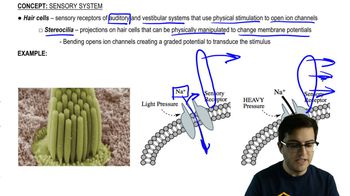
Identify the role of hair cells, which are sensory cells with hair-like projections that respond to mechanical stimuli by bending.
Learn that when hair cells are bent against the tectorial membrane, they depolarize, leading to the release of neurotransmitters.
These neurotransmitters then stimulate sensory neurons, generating action potentials that travel to the brain, allowing sound perception.

Verified video answer for a similar problem:

This video solution was recommended by our tutors as helpful for the problem above.
Video duration:
45s
Was this helpful?

Key Concepts

Here are the essential concepts you must grasp in order to answer the question correctly.

Hair Cells and Tectorial Membrane Interaction

Hair cells are sensory receptors located in the cochlea of the inner ear. They play a crucial role in hearing by converting mechanical sound vibrations into electrical signals. When sound waves cause the basilar membrane to vibrate, hair cells bend against the tectorial membrane, leading to depolarization and neurotransmitter release, which stimulates auditory neurons.
Recommended video:

Basilar Membrane Vibration

The basilar membrane is a structure within the cochlea that vibrates in response to sound waves. Different frequencies of sound cause specific regions of the basilar membrane to vibrate, allowing the ear to distinguish between various pitches. This mechanical movement is essential for the transduction of sound into neural signals, as it directly influences the bending of hair cells.
Recommended video:
Guided course
06:04
Biological Membranes

Middle Ear Amplification

The middle ear contains three small bones: the malleus, incus, and stapes, collectively known as the ossicles. These bones amplify sound vibrations from the eardrum to the oval window of the cochlea. This amplification is crucial for efficient transmission of sound energy into the fluid-filled inner ear, where it can be further processed into electrical signals by hair cells.
Recommended video:
Guided course
06:10
Signal Amplification