
Pearson+ LogoPearson+ Logo
Ch. 51 Animal Behavior
Campbell - Campbell Biology 11th Edition
Urry11th EditionCampbell BiologyISBN: 9789357423311Not the one you use?Change textbook
Chapter 51, Problem 5

Although many chimpanzees live in environments with oil palm nuts, members of only a few populations use stones to crack open the nuts. The likely explanation is that
a. The behavioral difference is caused by genetic differences between populations.
b. Members of different populations have different nutritional requirements.
c. The cultural tradition of using stones to crack nuts has arisen in only some populations.
d. Members of different populations differ in learning ability.

Verified step by step guidance
1
Identify the key behavior being discussed: the use of stones by chimpanzees to crack open oil palm nuts.
Consider the possible explanations for this behavior: genetic differences, nutritional requirements, cultural traditions, and learning abilities.
Evaluate the role of genetic differences: If genetic differences were the cause, we would expect to see consistent behavioral differences across all members of a population, which is not the case here.
Assess the nutritional requirements: Different nutritional needs would not necessarily lead to the use of tools unless there was a cultural or learned component involved.
Analyze the cultural tradition explanation: Cultural traditions can vary between populations and are often passed down through learning and imitation, making this a plausible explanation for why only some populations use stones to crack nuts.

Verified video answer for a similar problem:

This video solution was recommended by our tutors as helpful for the problem above.
Video duration:
2m
Was this helpful?

Key Concepts

Here are the essential concepts you must grasp in order to answer the question correctly.

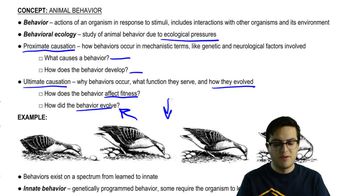
Cultural Traditions in Animal Behavior

Cultural traditions in animal behavior refer to learned behaviors that are passed down through generations within a population. These behaviors are not genetically inherited but are acquired through social learning and observation. In the context of chimpanzees, the use of stones to crack nuts may be a cultural tradition that has developed in certain groups, highlighting the role of social learning in behavior.
Recommended video:

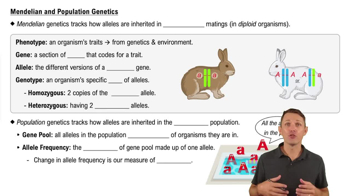
Genetic Differences in Populations

Genetic differences between populations can lead to variations in behavior, physiology, and adaptation. These differences arise due to mutations, natural selection, and genetic drift, which can result in distinct traits among populations. However, in the case of chimpanzees using tools, genetic differences are less likely to explain the behavior, as tool use is typically learned rather than inherited.
Recommended video:
04:26
Mendelian and Population Genetics

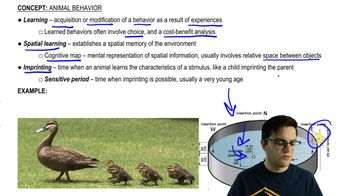
Learning Ability in Animals

Learning ability in animals refers to the capacity to acquire new skills or knowledge through experience, observation, or teaching. This ability can vary among individuals and populations, influencing how behaviors are adopted and spread. In chimpanzees, differences in learning ability could affect the adoption of tool use, but cultural transmission is a more plausible explanation for the observed behavior.
Recommended video:
Guided course
05:37
Learning and Communication
Related Practice
Textbook Question

According to Hamilton's rule,

a. Natural selection does not favor altruistic behavior that causes the death of the altruist.

b. Natural selection favors altruistic acts when the resulting benefit to the recipient, corrected for relatedness, exceeds the cost to the altruist.

c. Natural selection is more likely to favor altruistic behavior that benefits an offspring than altruistic behavior that benefits a sibling.

d. The effects of kin selection are larger than the effects of direct natural selection on individuals.

1791
views
Textbook Question

Female spotted sandpipers aggressively court males and, after mating, leave the clutch of young for the male to incubate. This sequence may be repeated several times with different males until no available males remain, forcing the female to incubate her last clutch. Which of the following terms best describes this behavior?

a. Polygyny

b. Polyandry

c. Promiscuity

d. Certainty of paternity

1051
views
Textbook Question

A region of the canary forebrain shrinks during the nonbreeding season and enlarges when breeding season begins. This change is probably associated with the annual

a. Addition of new syllables to a canary's song repertoire

b. Crystallization of subsong into adult songs

c. Sensitive period in which canary parents imprint on new offspring

d. Elimination of the memorized template for songs sung the previous year

800
views
Textbook Question

Which of the following is not required for a behavioral trait to evolve by natural selection?

a. In each individual, the form of the behavior is determined entirely by genes.

b. The behavior varies among individuals.

c. An individual's reproductive success depends in part on how the behavior is performed.

d. Some component of the behavior is genetically inherited.

1328
views