
Textbook Question
According to the island equilibrium model, species richness would be greatest on an island that is
a. Large and remote
b. Small and remote
c. Large and close to a mainland
d. Small and close to a mainland
1098
views

 Verified step by step guidance
 03:31
03:31
 06:50
06:50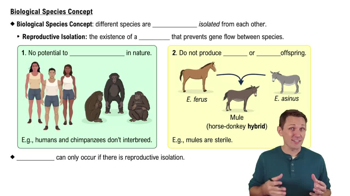 03:24
03:24According to the island equilibrium model, species richness would be greatest on an island that is
a. Large and remote
b. Small and remote
c. Large and close to a mainland
d. Small and close to a mainland
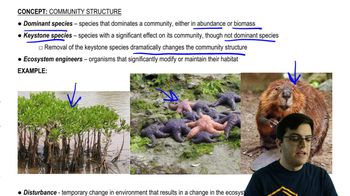
Predators that are keystone species can maintain species diversity in a community if they
a. Competitively exclude other predators
b. Prey on the community's dominant species
c. Reduce the number of disruptions in the community
d. Prey only on the least abundant species in the community
Food chains are sometimes short because
a. Only a single species of herbivore feeds on each plant species.
b. Local extinction of a species causes extinction of the other species in its food chain.
c. Most of the energy in a trophic level is lost as energy passes to the next higher level.
d. Most producers are inedible.
The feeding relationships among the species in a community determine the community's
a. Secondary succession
b. Ecological niche
c. Species richness
d. Trophic structure
The principle of competitive exclusion states that
a. Two species cannot coexist in the same habitat.
b. Competition between two species always causes extinction or emigration of one species.
c. Two species that have exactly the same niche cannot coexist in a community.
d. Two species will stop reproducing until one species leaves the habitat.