Pearson+ LogoPearson+ Logo
Ch. 54 - Community Ecology
Campbell - Campbell Biology 11th Edition
Urry11th EditionCampbell BiologyISBN: 9789357423311Not the one you use?Change textbook
Chapter 54, Problem 7

Which of the following could qualify as a top-down control on a grassland community?
a. Limitation of plant biomass by rainfall amount
b. Influence of temperature on competition among plants
c. Influence of soil nutrients on the abundance of grasses versus wildflowers
d. Effect of grazing intensity by bison on plant species diversity

Verified step by step guidance
1
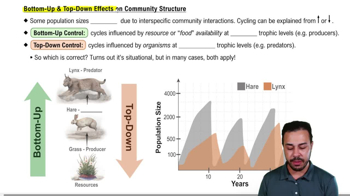
Understand the concept of top-down control: In ecology, top-down control refers to the influence of predators or consumers on the structure and dynamics of ecosystems. It contrasts with bottom-up control, which is driven by resource availability such as nutrients or sunlight.
Analyze each option to determine if it represents a top-down control: Top-down control typically involves the impact of higher trophic levels (like predators or herbivores) on lower trophic levels (like plants).
Evaluate option a: Limitation of plant biomass by rainfall amount is a bottom-up control because it involves abiotic factors affecting plant growth.
Evaluate option b: Influence of temperature on competition among plants is also a bottom-up control, as it involves abiotic factors affecting plant interactions.
Evaluate option d: Effect of grazing intensity by bison on plant species diversity is a top-down control, as it involves herbivores (bison) affecting the diversity and composition of plant species in the grassland community.

Verified video answer for a similar problem:

This video solution was recommended by our tutors as helpful for the problem above.
Video duration:
1m
Was this helpful?

Key Concepts

Here are the essential concepts you must grasp in order to answer the question correctly.

Top-Down Control

Top-down control refers to the influence of higher trophic levels on the structure and dynamics of ecosystems. In a grassland community, this could involve predators or herbivores affecting the abundance and diversity of plant species. For example, grazing by bison can regulate plant species diversity by selectively feeding on certain plants, thereby shaping the community composition.
Recommended video:
Guided course
05:06
Bottom-Up & Top-Down Effects on Community Structure

Trophic Levels

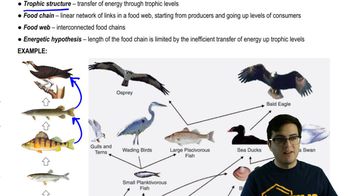
Trophic levels are the hierarchical levels in an ecosystem, comprising producers, consumers, and decomposers. Each level represents a step in the food chain, with energy and nutrients flowing from one level to the next. Understanding trophic levels is crucial for identifying how top-down controls, such as herbivory, can impact lower levels like plant communities in grasslands.
Recommended video:
Guided course
03:14
Trophic Structure

Community Dynamics

Community dynamics involve the interactions and changes within an ecological community over time. Factors such as predation, competition, and environmental conditions can influence these dynamics. In the context of the question, grazing intensity by bison represents a biotic factor that can alter plant species diversity, demonstrating a top-down control mechanism in the grassland ecosystem.
Recommended video:
Guided course
03:01
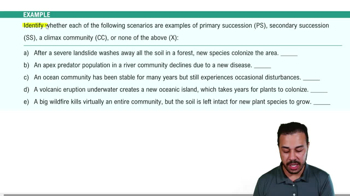
Community Dynamics Example 1
Related Practice
Textbook Question

According to the island equilibrium model, species richness would be greatest on an island that is

a. Large and remote

b. Small and remote

c. Large and close to a mainland

d. Small and close to a mainland

1097
views
Textbook Question

Predators that are keystone species can maintain species diversity in a community if they

a. Competitively exclude other predators

b. Prey on the community's dominant species

c. Reduce the number of disruptions in the community

d. Prey only on the least abundant species in the community

1775
views
Textbook Question

Food chains are sometimes short because

a. Only a single species of herbivore feeds on each plant species.

b. Local extinction of a species causes extinction of the other species in its food chain.

c. Most of the energy in a trophic level is lost as energy passes to the next higher level.

d. Most producers are inedible.

1623
views
Textbook Question

The most plausible hypothesis to explain why species richness is higher in tropical than in temperate regions is that

a. Tropical communities are younger.

b. Tropical regions generally have more available water and higher levels of solar radiation.

c. Higher temperatures cause more rapid speciation.

d. Diversity increases as evapotranspiration decreases.

1450
views
Textbook Question

Community 1 contains 100 individuals distributed among four species: 5A, 5B, 85C, and 5D. Community 2 contains 100 individuals distributed among three species: 30A, 40B, and 30C. Calculate the Shannon diversity (H) for each community. Which community is more diverse?

1724
views