
Pearson+ LogoPearson+ Logo
Ch. 56 - Conservation Biology and Global Change
Campbell - Campbell Biology 11th Edition
Urry11th EditionCampbell BiologyISBN: 9789357423311Not the one you use?Change textbook
Chapter 56, Problem 6

Of the following statements about protected areas that have been established to preserve biodiversity, which one is not correct?
a. About 25% of Earth's land area is now protected.
b. National parks are one of many types of protected areas.
c. Management of a protected area should be coordinated with management of the land surrounding the area.
d. It is especially important to protect biodiversity hot spots.

Verified step by step guidance
1
Step 1: Begin by understanding the concept of protected areas. Protected areas are regions designated to conserve biodiversity and natural resources. They include national parks, wildlife reserves, and other conservation zones.
Step 2: Analyze each statement provided in the question to determine its accuracy. For example, statement (a) claims that about 25% of Earth's land area is protected. Research global statistics on protected land to verify this claim.
Step 3: Evaluate statement (b), which mentions national parks as one type of protected area. Confirm that national parks are indeed a recognized category of protected areas, along with other types such as nature reserves and marine protected areas.
Step 4: Examine statement (c), which suggests that the management of protected areas should be coordinated with the surrounding land. Consider ecological principles, such as habitat connectivity and buffer zones, to assess the validity of this statement.
Step 5: Assess statement (d), which emphasizes the importance of protecting biodiversity hot spots. Review the concept of biodiversity hot spots—regions with high species richness and endemism—and their significance in conservation efforts.

Verified video answer for a similar problem:

This video solution was recommended by our tutors as helpful for the problem above.
Video duration:
1m
Was this helpful?

Key Concepts

Here are the essential concepts you must grasp in order to answer the question correctly.

Biodiversity and Protected Areas

Biodiversity refers to the variety of life on Earth, encompassing different species, ecosystems, and genetic diversity. Protected areas are designated regions aimed at conserving this biodiversity by limiting human activities that can lead to habitat destruction and species extinction. Understanding the role of protected areas is crucial for evaluating their effectiveness in preserving biodiversity.
Recommended video:
Guided course
05:06
Biodiversity and Sustainability

Types of Protected Areas

Protected areas can take various forms, including national parks, wildlife reserves, and marine protected areas. Each type serves different purposes and has specific regulations governing land use and conservation efforts. Recognizing the diversity of protected area types helps in understanding their roles in biodiversity conservation and the management strategies employed.
Recommended video:
Guided course
04:08
2) mRNA Protection in the Cytoplasm

Biodiversity Hotspots

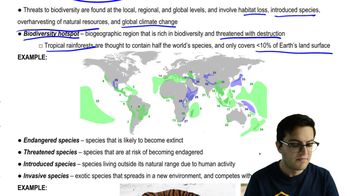
Biodiversity hotspots are regions that are both rich in endemic species and significantly threatened by human activities. Protecting these areas is critical because they contain a high concentration of unique species that are at risk of extinction. The importance of safeguarding biodiversity hotspots highlights the need for targeted conservation efforts to maintain global biodiversity.
Recommended video:
Guided course
04:32
Biodiversity Hotspots and Endangered Species