
Pearson+ LogoPearson+ Logo
Ch. 56 - Conservation Biology and Global Change
Campbell - Campbell Biology 11th Edition
Urry11th EditionCampbell BiologyISBN: 9789357423311Not the one you use?Change textbook
Chapter 56, Problem 4

Which of these is a consequence of biological magnification?
a. Toxic chemicals in the environment pose greater risk to top-level predators than to primary consumers.
b. Populations of top-level predators are generally smaller than populations of primary consumers.
c. The biomass of producers in an ecosystem is generally higher than the biomass of primary consumers.
d. Only a small portion of the energy captured by producers is transferred to consumers.

Verified step by step guidance
1
Understand the role of fungi in an ecosystem: Fungi are decomposers, meaning they break down dead organic matter, recycling nutrients back into the ecosystem.
Consider the effect of a fungicide: A fungicide is a chemical that kills fungi. Applying it to a cornfield would reduce the population of fungi, thereby affecting decomposition.
Analyze the impact on decomposition rate: With fewer fungi, the rate of decomposition would likely decrease because there are fewer organisms to break down organic matter.
Evaluate the effect on net ecosystem production (NEP): NEP is the balance between the total amount of carbon fixed by photosynthesis and the total amount of carbon released by respiration. If decomposition decreases, less carbon is released back into the atmosphere, potentially increasing NEP.
Conclude the expected changes: Based on the analysis, applying a fungicide would likely decrease the decomposition rate and increase NEP, aligning with option d.

Verified video answer for a similar problem:

This video solution was recommended by our tutors as helpful for the problem above.
Video duration:
2m
Was this helpful?

Key Concepts

Here are the essential concepts you must grasp in order to answer the question correctly.

Decomposition Rate

Decomposition rate refers to the speed at which organic matter is broken down by decomposers, such as fungi and bacteria, into simpler substances. This process is crucial for nutrient cycling in ecosystems, as it releases nutrients back into the soil, making them available for plant uptake. Applying a fungicide can reduce the population of fungi, potentially slowing down the decomposition rate.
Recommended video:
Guided course
07:08
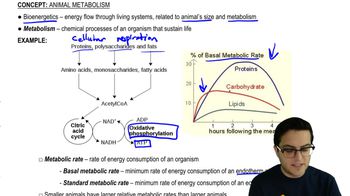
Metabolic Rate

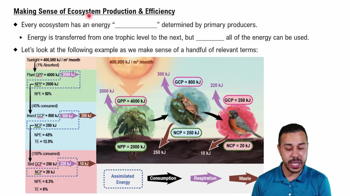
Net Ecosystem Production (NEP)

Net Ecosystem Production (NEP) is the balance between the total amount of carbon dioxide absorbed by photosynthesis and the carbon dioxide released through respiration and decomposition in an ecosystem. NEP indicates the net carbon storage in an ecosystem. If decomposition decreases due to fungicide application, less carbon is released, potentially increasing NEP as more carbon is stored.
Recommended video:
Guided course
07:47
Making Sense of Ecosystem Production & Efficiency

Impact of Fungicides

Fungicides are chemical agents used to kill or inhibit the growth of fungi. In agricultural settings, they are applied to protect crops from fungal diseases. However, their use can disrupt the natural decomposition process by reducing fungal populations, which are key decomposers. This disruption can affect nutrient cycling and carbon dynamics, influencing both decomposition rates and NEP.
Recommended video:
Guided course
03:35
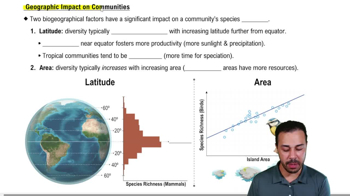
Geographic Impact on Communities
Related Practice
Textbook Question

One characteristic that distinguishes a population in an extinction vortex from most other populations is that

a. It is a rare, top-level predator

b. Its effective population size is lower than its total population size

c. Its genetic diversity is very low

d. It is not well adapted to edge conditions

913
views
1
comments
Textbook Question

The main cause of the increase in the amount of CO₂ in Earth's atmosphere over the past 150 years is

a. Increased worldwide primary production

b. Increased worldwide standing crop

c. An increase in the amount of infrared radiation absorbed by the atmosphere

d. The burning of larger amounts of wood and fossil fuels

1336
views
Textbook Question

What is the single greatest threat to biodiversity?

a. Overharvesting of commercially important species

b. Habitat alteration, fragmentation, and destruction

c. Introduced species that compete with native species

d. Novel pathogens

1251
views
Textbook Question

Which of the following strategies would most rapidly increase the genetic diversity of a population in an extinction vortex?

a. Establish a reserve that protects the population's habitat

b. Introduce new individuals transported from other populations of the same species

c. Sterilize the least fit individuals in the population

d. Control populations of the endangered population's predators and competitors

1233
views
Textbook Question

Of the following statements about protected areas that have been established to preserve biodiversity, which one is not correct?

a. About 25% of Earth's land area is now protected.

b. National parks are one of many types of protected areas.

c. Management of a protected area should be coordinated with management of the land surrounding the area.

d. It is especially important to protect biodiversity hot spots.

1014
views