Pearson+ LogoPearson+ Logo
Ch. 6 - A Tour of the Cell
Campbell - Campbell Biology 11th Edition
Urry11th EditionCampbell BiologyISBN: 9789357423311Not the one you use?Change textbook
Chapter 6, Problem 1

Which structure is not part of the endomembrane system?
a. Nuclear envelope
b. Chloroplast
c. Golgi apparatus
d. Plasma membrane

Verified step by step guidance
1
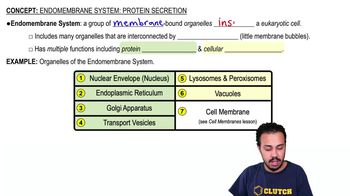
Understand the components of the endomembrane system. The endomembrane system is a group of membranes and organelles in eukaryotic cells that work together to modify, package, and transport lipids and proteins. It includes the nuclear envelope, endoplasmic reticulum, Golgi apparatus, lysosomes, vacuoles, and the plasma membrane.
Identify the function of each structure listed in the options. The nuclear envelope surrounds the nucleus and is part of the endomembrane system. The Golgi apparatus modifies, sorts, and packages proteins and lipids, and is part of the endomembrane system. The plasma membrane is the cell's outer membrane and is part of the endomembrane system.
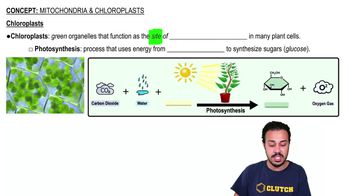
Consider the chloroplast. Chloroplasts are involved in photosynthesis and are found in plant cells. They have their own DNA and are not part of the endomembrane system.
Recognize that chloroplasts are similar to mitochondria in that they are semi-autonomous organelles with their own DNA and ribosomes, and they are not derived from the endomembrane system.
Conclude that the structure not part of the endomembrane system is the chloroplast, as it functions independently from the system and is involved in energy conversion rather than the modification and transport of proteins and lipids.

Verified video answer for a similar problem:

This video solution was recommended by our tutors as helpful for the problem above.
Video duration:
2m
Was this helpful?

Key Concepts

Here are the essential concepts you must grasp in order to answer the question correctly.

Endomembrane System

The endomembrane system is a group of membranes and organelles in eukaryotic cells that work together to modify, package, and transport lipids and proteins. It includes the nuclear envelope, endoplasmic reticulum, Golgi apparatus, lysosomes, and the plasma membrane. These components are interconnected either directly or through vesicle transport.
Recommended video:
Guided course
04:13
Endomembrane System: Protein Secretion

Chloroplast

Chloroplasts are organelles found in plant and algal cells responsible for photosynthesis. They contain their own DNA and are surrounded by a double membrane. Unlike components of the endomembrane system, chloroplasts are not involved in the transport or modification of proteins and lipids, making them distinct from the endomembrane system.
Recommended video:

Plasma Membrane

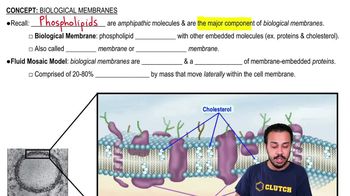
The plasma membrane is the outer boundary of the cell, composed of a lipid bilayer with embedded proteins. It regulates the movement of substances in and out of the cell and is part of the endomembrane system. It plays a crucial role in cell communication and maintaining the cell's environment, linking it to other components of the system.
Recommended video:
Guided course
06:04
Biological Membranes