63–68. Definite integrals Evaluate the following definite integrals. Use Theorem 7.7 to express your answer in terms of logarithms. ∫₁/₈¹ dx/x√(1 + x²/³)
Verified step by step guidance
1
First, rewrite the integral to clearly identify the integrand: \( \int_{\frac{1}{8}}^{1} \frac{1}{x \sqrt{1 + \frac{x^{2}}{3}}} \, dx \).
Simplify the expression inside the square root: \( \sqrt{1 + \frac{x^{2}}{3}} = \sqrt{\frac{3 + x^{2}}{3}} = \frac{\sqrt{3 + x^{2}}}{\sqrt{3}} \). Substitute this back into the integrand.
Rewrite the integrand as \( \frac{1}{x} \cdot \frac{\sqrt{3}}{\sqrt{3 + x^{2}}} = \frac{\sqrt{3}}{x \sqrt{3 + x^{2}}} \).
Consider a substitution to simplify the integral. Let \( t = \frac{\sqrt{3 + x^{2}}}{x} \). Then express \( dt \) in terms of \( dx \) and rewrite the integral in terms of \( t \).
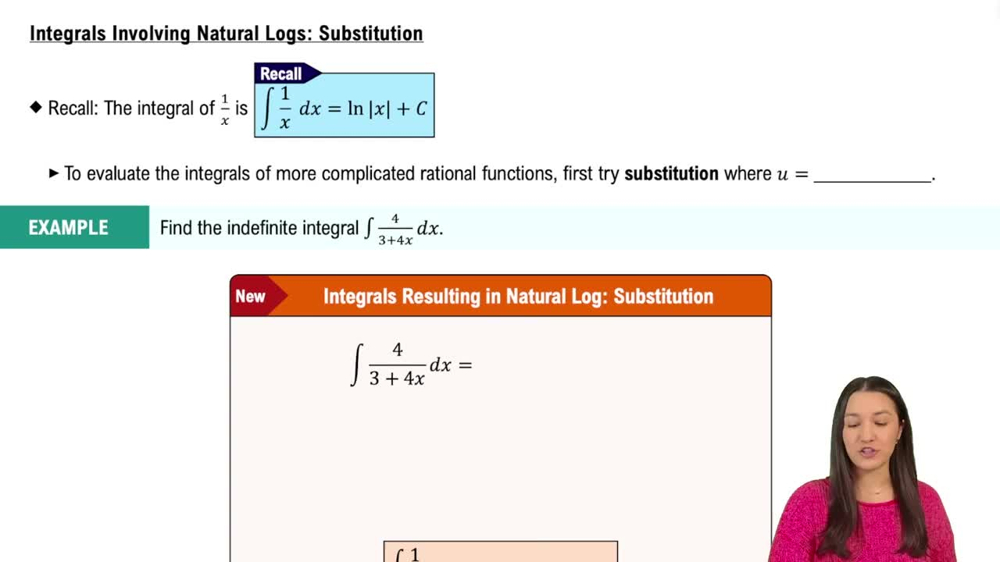
Use Theorem 7.7, which relates to integrals of the form \( \int \frac{f'(x)}{f(x)} dx = \ln|f(x)| + C \), to express the integral in terms of logarithms after substitution and simplification.
Verified video answer for a similar problem:
This video solution was recommended by our tutors as helpful for the problem above
Video duration:
10m
Play a video:
0 Comments
Key Concepts
Here are the essential concepts you must grasp in order to answer the question correctly.
Definite Integrals
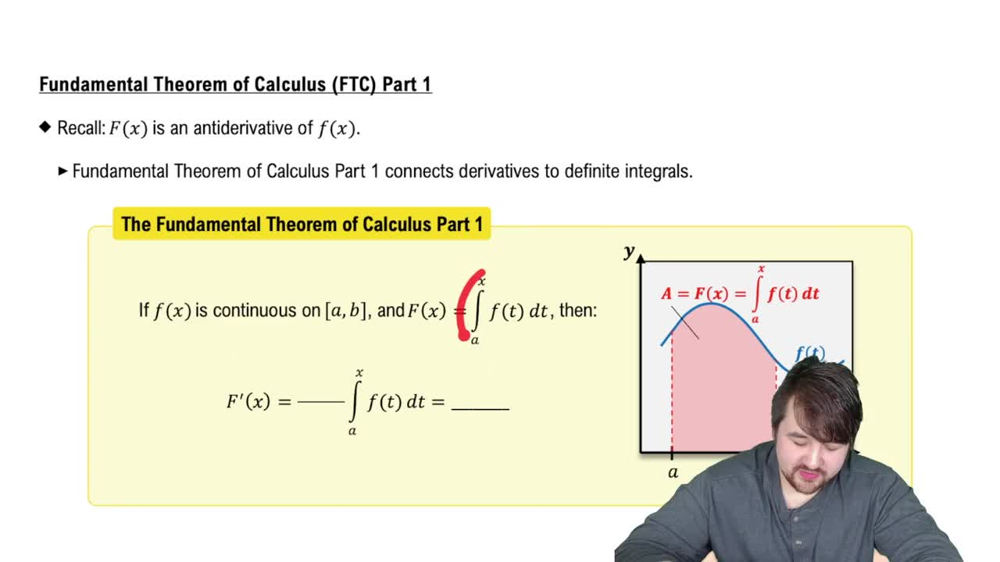
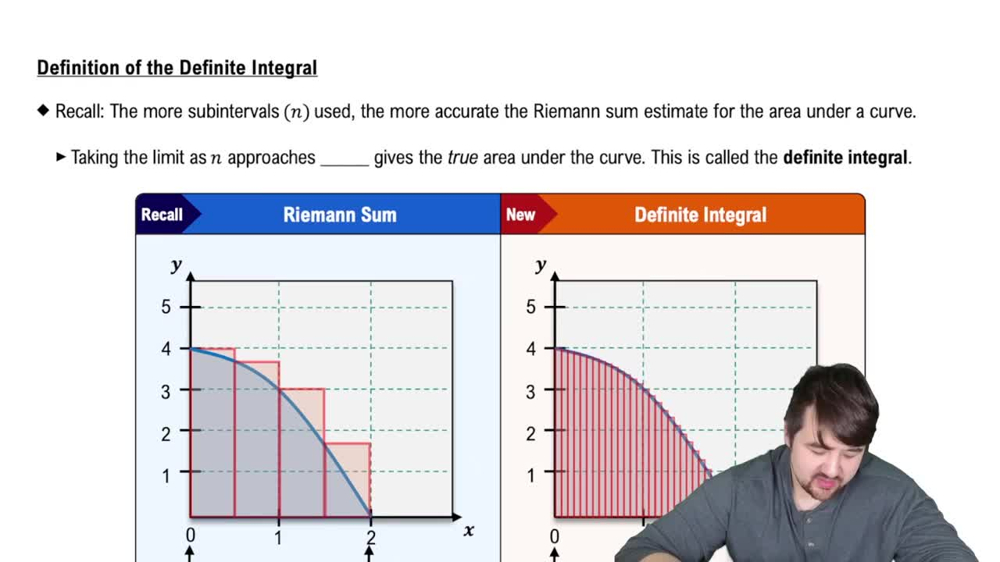
A definite integral calculates the net area under a curve between two specific limits. It is represented as ∫_a^b f(x) dx, where a and b are the lower and upper bounds. Evaluating definite integrals often involves finding an antiderivative and then applying the Fundamental Theorem of Calculus.
Integration Techniques for Functions Involving Roots and Rational Expressions
Integrals involving expressions like 1/(x√(1 + x^(2/3))) often require substitution or algebraic manipulation to simplify the integrand. Recognizing patterns or rewriting the integrand can help transform it into a form suitable for standard integral formulas or logarithmic expressions.
Theorem 7.7 typically refers to a result that expresses certain integrals in terms of logarithms, often involving integrals of the form ∫(f'(x)/f(x)) dx = ln|f(x)| + C. Applying this theorem helps rewrite the integral's antiderivative using logarithmic functions, which is essential for the problem's requirement.

 10:15 minutes
 Verified step by step guidance
 05:43
05:43