Ch. 1 - Functions
Hass - Thomas' Calculus 15th Edition
Hass15th EditionThomas' CalculusISBN: 9780137616077Not the one you use?Change textbook
Chapter 1, Problem 1.20

In Exercises 19–32, find the (a) domain and (b) range.
____
𝔂 = -2 + √1 - x

Verified step by step guidance
1
Step 1: Identify the expression inside the square root, which is '1 - x'. The square root function is defined only for non-negative values, so set up the inequality 1 - x ≥ 0.
Step 2: Solve the inequality 1 - x ≥ 0 to find the domain of the function. Rearrange the inequality to find the values of x that satisfy it.
Step 3: The domain of the function is the set of x-values for which the expression inside the square root is non-negative. Express this domain in interval notation.
Step 4: To find the range, consider the values that the expression √(1 - x) can take. Since the square root function outputs non-negative values, determine the minimum and maximum values of √(1 - x).
Step 5: The range of the function is determined by the expression -2 + √(1 - x). Calculate the minimum and maximum values of this expression based on the domain found in Step 3, and express the range in interval notation.

Verified video answer for a similar problem:

This video solution was recommended by our tutors as helpful for the problem above.
Video duration:
3m
Was this helpful?

Key Concepts

Here are the essential concepts you must grasp in order to answer the question correctly.

Domain of a Function

The domain of a function refers to the set of all possible input values (x-values) for which the function is defined. For the function y = -2 + √(1 - x), the expression under the square root must be non-negative, which imposes restrictions on x. Thus, determining the domain involves solving the inequality 1 - x ≥ 0.
Recommended video:
5:10
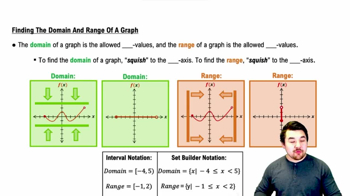
Finding the Domain and Range of a Graph

Range of a Function

The range of a function is the set of all possible output values (y-values) that the function can produce. For the function y = -2 + √(1 - x), the square root function outputs non-negative values, which means the minimum value of y occurs when x is at its maximum in the domain. Analyzing the function helps identify the range based on the values y can take.
Recommended video:
5:10
Finding the Domain and Range of a Graph

Square Root Function

The square root function, denoted as √x, is defined for non-negative values of x and produces non-negative outputs. In the context of the function y = -2 + √(1 - x), the square root affects both the domain and range, as it restricts x to values where 1 - x is non-negative, and it shifts the output down by 2, impacting the overall range.
Recommended video:
7:24
Multiplying & Dividing Functions