Area: Find the area between the x-axis and the curve y = √(1 + cos 4x), for 0 ≤ x ≤ π.
Ch. 8 - Techniques of Integration
Chapter 8, Problem 8.7.23
Volume of water in a swimming pool
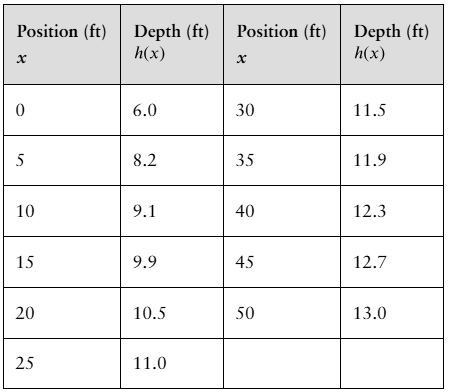
A rectangular swimming pool is 30 ft wide and 50 ft long. The accompanying table shows the depth h(x) of the water at 5-ft intervals from one end of the pool to the other. Estimate the volume of water in the pool using the Trapezoidal Rule with n = 10 applied to the integral
V = ∫ from 0 to 50 of 30 · h(x) dx.

Verified step by step guidance1
Identify the integral to estimate the volume of water in the pool: \(V = \int_0^{50} 30 \cdot h(x) \, dx\), where 30 ft is the width of the pool and \(h(x)\) is the depth at position \(x\).
Note that the depth values \(h(x)\) are given at 5-ft intervals from \(x=0\) to \(x=50\), so the interval width is \(\Delta x = 5\) ft, and the number of subintervals is \(n=10\).
Apply the Trapezoidal Rule formula for \(n=10\) subintervals:
\(\int_a^b f(x) \, dx \approx \frac{\Delta x}{2} \left[f(x_0) + 2f(x_1) + 2f(x_2) + \cdots + 2f(x_{n-1}) + f(x_n)\right]\),
where \(f(x) = 30 \cdot h(x)\) in this problem.
Calculate \(f(x_i) = 30 \times h(x_i)\) for each depth value \(h(x_i)\) from the table, then substitute these values into the trapezoidal sum expression.
Finally, multiply the sum by \(\frac{\Delta x}{2} = \frac{5}{2}\) to estimate the volume \(V\). This will give the approximate volume of water in the pool.

Verified video answer for a similar problem:
This video solution was recommended by our tutors as helpful for the problem above.
Video duration:
7mWas this helpful?
Key Concepts
Here are the essential concepts you must grasp in order to answer the question correctly.
Definite Integral as Volume Calculation
The definite integral ∫ from a to b of a function represents the accumulation of quantities, such as area or volume. In this problem, the integral V = ∫ from 0 to 50 of 30 · h(x) dx calculates the volume of water by integrating the cross-sectional area (width times depth) along the pool's length.
Recommended video:
Definition of the Definite Integral
Trapezoidal Rule for Numerical Integration
The Trapezoidal Rule approximates the value of a definite integral by dividing the interval into subintervals and approximating the area under the curve as trapezoids. It is especially useful when the function values are known at discrete points, as in the given depth table.
Recommended video:
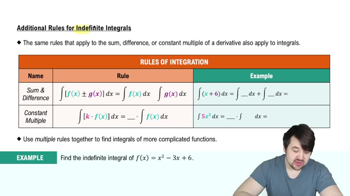
Additional Rules for Indefinite Integrals
Using Discrete Data Points for Approximation
When a function is given only at specific points, numerical methods like the Trapezoidal Rule use these discrete values to estimate integrals. Here, the depth h(x) is provided at 5-ft intervals, allowing the approximation of the integral and thus the volume of water.
Recommended video:
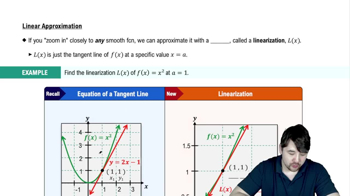
Linearization
Related Practice
Textbook Question
48
views
Textbook Question
In Exercises 33–38, perform long division on the integrand, write the proper fraction as a sum of partial fractions, and then evaluate the integral.
∫ 2y⁴ / (y³ - y² + y - 1) dy
17
views
Textbook Question
Solve the initial value problems in Exercises 67–70 for x as a function of t.
(t + 1) (dx/dt) = x² + 1 (for t > -1), x(0) = 0
24
views
Textbook Question
Evaluate the integrals in Exercises 31–56. Some integrals do not require integration by parts.
∫ x² tan⁻¹(x / 2) dx
25
views
Textbook Question
The integrals in Exercises 1–44 are in no particular order. Evaluate each integral using any algebraic method, trigonometric identity, or substitution you think is appropriate.
∫ ((2ˣ - 1) / 3ˣ) dx
22
views
Textbook Question
Use the table of integrals at the back of the text to evaluate the integrals in Exercises 1–26.
∫ e^(-3t) sin(4t) dt
31
views