
Ch. 6 - Applications of Integration
Briggs - Calculus: Early Transcendentals 3rd Edition
Briggs3rd EditionCalculus: Early TranscendentalsISBN: 9780136847243Not the one you use?Change textbook
Chapter 6, Problem 6.1.19a

17–22. Position from velocity Consider an object moving along a line with the given velocity v and initial position.


a. Determine the position function, for t≥0, using the antiderivative method


v(t) = 6−2t on [0, 5]; s(0)=0

Verified step by step guidance
1
Identify the given velocity function: \(v(t) = 6 - 2t\) and the initial position \(s(0) = 0\).
Recall that the position function \(s(t)\) is the antiderivative (indefinite integral) of the velocity function \(v(t)\), so write \(s(t) = \int v(t) \, dt + C\).
Integrate the velocity function: compute \(\int (6 - 2t) \, dt\) by integrating each term separately.
After integration, express \(s(t)\) as \(s(t) = 6t - t^2 + C\), where \(C\) is the constant of integration.
Use the initial condition \(s(0) = 0\) to solve for \(C\) by substituting \(t=0\) into \(s(t)\) and setting it equal to zero.

Verified video answer for a similar problem:

This video solution was recommended by our tutors as helpful for the problem above.
Video duration:
1m
Was this helpful?

Key Concepts

Here are the essential concepts you must grasp in order to answer the question correctly.

Velocity and Position Relationship

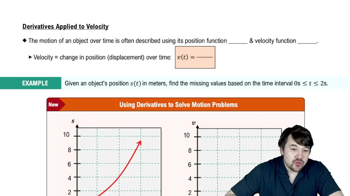
Velocity is the rate of change of position with respect to time. The position function can be found by integrating the velocity function over time, which accumulates the changes in position from the initial point.
Recommended video:
06:29
Derivatives Applied To Velocity

Antiderivative (Indefinite Integral)

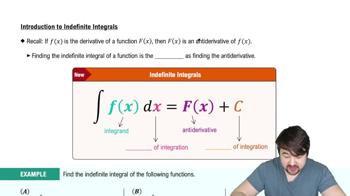
The antiderivative of a function is another function whose derivative is the original function. Finding the antiderivative of velocity gives the position function up to a constant, which can be determined using initial conditions.
Recommended video:
05:04
Introduction to Indefinite Integrals

Initial Conditions and Constants of Integration

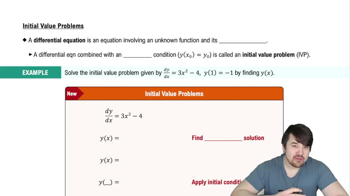
When integrating to find position from velocity, an unknown constant appears. The initial position value (e.g., s(0) = 0) is used to solve for this constant, ensuring the position function accurately reflects the object's starting point.
Recommended video:
05:03
Initial Value Problems
Related Practice
Textbook Question

Emptying a conical tank A water tank is shaped like an inverted cone with height 6 m and base radius 1.5 m (see figure).

a. If the tank is full, how much work is required to pump the water to the level of the top of the tank and out of the tank?

154
views
Textbook Question

17–22. Position from velocity Consider an object moving along a line with the given velocity v and initial position.


a. Determine the position function, for t≥0, using the antiderivative method


v(t) = −t³+3t²−2t on [0, 3]; s(0)=4

33
views
Textbook Question

Blood flow A typical human heart pumps 70 mL of blood (the stroke volume) with each beat. Assuming a heart rate of 60 beats/min (1 beat/s), a reasonable model for the outflow rate of the heart is V′(t)=70(1+sin 2πt), where V(t) is the amount of blood (in milliliters) pumped over the interval [0,t],V(0)=0 and t is measured in seconds.


a. Verify that the amount of blood pumped over a one-second interval is 70 mL.

162
views
Textbook Question

{Use of Tech} Oscillating motion A mass hanging from a spring is set in motion, and its ensuing velocity is given by v(t) = 2π cos πt, for t≥0. Assume the positive direction is upward and s(0)=0. 


a. Determine the position function, for t≥0.

68
views
Textbook Question

Depletion of natural resources Suppose r(t) = r0e^−kt, with k>0, is the rate at which a nation extracts oil, where r0=10⁷ barrels/yr is the current rate of extraction. Suppose also that the estimate of the total oil reserve is 2×10⁹ barrels. 


a. Find Q(t), the total amount of oil extracted by the nation after t years.

47
views
Textbook Question

For the given regions R₁ and R₂, complete the following steps.


a. Find the area of region R₁.


R₁ is the region in the first quadrant bounded by the y-axis and the curves y=2x^2 and y=3−x; R₂ is the region in the first quadrant bounded by the x-axis and the curves y=2x^2 and y=3−x(see figure).

47
views