Ch. 7 - Transcendental Functions
Hass - Thomas' Calculus 15th Edition
Hass15th EditionThomas' CalculusISBN: 9780137616077Not the one you use?Change textbook
Chapter 7, Problem 7.3.57

Solve the initial value problems in Exercises 55–58.


57. d²y/dx² = 2e^(−x),y(0) = 1,y′(0) = 0

Verified step by step guidance
1
Identify the given differential equation and initial conditions: \( \frac{d^{2}y}{dx^{2}} = 2e^{-x} \), with \( y(0) = 1 \) and \( y'(0) = 0 \).
Integrate the second derivative \( \frac{d^{2}y}{dx^{2}} \) once with respect to \( x \) to find the first derivative \( y'(x) \). This gives \( y'(x) = \int 2e^{-x} \, dx + C_1 \), where \( C_1 \) is a constant of integration.
Perform the integration \( \int 2e^{-x} \, dx \) by recalling that \( \int e^{ax} \, dx = \frac{1}{a} e^{ax} + C \). Substitute the result back to express \( y'(x) \) including the constant \( C_1 \).
Integrate \( y'(x) \) with respect to \( x \) to find \( y(x) \). This will introduce another constant of integration \( C_2 \). So, \( y(x) = \int y'(x) \, dx = \int (\text{expression from previous step}) \, dx + C_2 \).
Use the initial conditions \( y(0) = 1 \) and \( y'(0) = 0 \) to set up equations and solve for the constants \( C_1 \) and \( C_2 \). Substitute these constants back into the expression for \( y(x) \) to get the particular solution.

Verified video answer for a similar problem:

This video solution was recommended by our tutors as helpful for the problem above.
Video duration:
6m
Was this helpful?

Key Concepts

Here are the essential concepts you must grasp in order to answer the question correctly.

Second-Order Differential Equations

A second-order differential equation involves the second derivative of an unknown function. Solving it requires finding a function y(x) whose second derivative matches the given expression. The general solution often includes two arbitrary constants, reflecting the equation's order.
Recommended video:
07:39
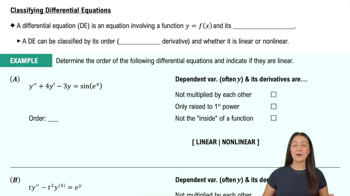
Classifying Differential Equations

Initial Conditions and Initial Value Problems

Initial conditions specify the values of a function and its derivatives at a particular point, allowing determination of the arbitrary constants in the general solution. An initial value problem combines a differential equation with these conditions to find a unique solution.
Recommended video:
Guided course
05:03
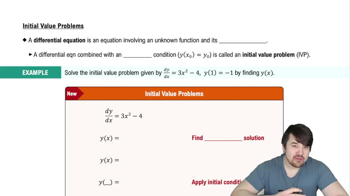
Initial Value Problems

Integration of Exponential Functions

Solving the differential equation involves integrating the right-hand side function, here an exponential function e^(−x). Understanding how to integrate exponentials and apply constants of integration is essential to find the general solution before applying initial conditions.
Recommended video:
05:11
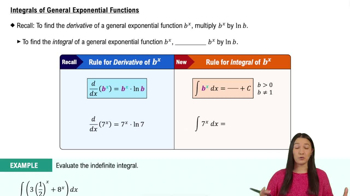
Integrals of General Exponential Functions
Related Practice
Textbook Question

Since the hyperbolic functions can be expressed in terms of exponential functions, it is possible to express the inverse hyperbolic functions in terms of logarithms, as shown in the following table.

sinh⁻¹x = ln(x + √(x² + 1)), -∞ < x < ∞

cosh⁻¹x = ln(x + √(x² - 1)), x ≥ 1

tanh⁻¹x = (1/2)ln((1+x)/(1-x)), |x| < 1

sech⁻¹x = ln((1+√(1-x²))/x), 0 < x ≤ 1

csch⁻¹x = ln(1/x + √(1+x²)/|x|), x ≠ 1

coth⁻¹x = (1/2)ln((x+1)/(x-1)), |x| > 1

Use these formulas to express the numbers in Exercises 61–66 in terms of natural logarithms.

63. tanh⁻¹(-1/2)

35
views
Textbook Question

25. First-order chemical reactions In some chemical reactions, the rate at which the amount of a substance changes with time is proportional to the amount present. For the change of δ-gluconolactone into gluconic acid, for example,

dy/dt = -0.6y

when t is measured in hours. If there are 100 grams of δ-gluconolactone present when t=0, how many grams will be left after the first hour?

55
views
Textbook Question

130. Use the identity arccot(u)=π/2 - arctan(u) to derive the formula for the derivative of arccot(u) in Table 7.4 from the formula for the derivative of arctan(u).

32
views
Textbook Question

Evaluate the integrals in Exercises 91–102.

102. ∫(from -1/3 to 1/√3)(cos(arctan 3x))/(1+9x²) dx

32
views
Textbook Question

In Exercises 115–126, use logarithmic differentiation or the method in Example 6 to find the derivative of y with respect to the given independent variable.

122. y = (ln x)^(ln x)

29
views
Textbook Question

In Exercises 57–70, use logarithmic differentiation to find the derivative of y with respect to the given independent variable.

66. y = θsin(θ)/√(sec(θ))

40
views