Back
Back
Problem 7.1.47c
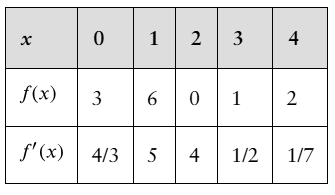
Suppose that the function f and its derivative with respect to x have the following values at x=0, 1, 2, 3, and 4.
Assuming the inverse function f^(-1) is differentiable, find the slope of f^(-1)(x) at
c. x=3
Problem 7.6.7c
Use reference triangles in an appropriate quadrant to find the angles in Exercises 1–8.
7. c. arcsec(-2)
Problem 7.4.23c
23. Human evolution continues The analysis of tooth shrinkage by C. Loring Brace and colleagues at the University of Michigan’s Museum of Anthropology indicates that human tooth size is continuing to decrease and that the evolutionary process has not yet come to a halt. In northern Europeans, for example, tooth size reduction now has a rate of 1% per 1000 years.
c. What will be our descendants’ tooth size 20,000 years from now (as a percentage of our present tooth size)?
Problem 7.8.4c
4. Which of the following functions grow faster than x² as x→∞? Which grow at the same rate as x²? Which grow slower?
c. x²e^(-x)
Problem 7.1.40c
What can you conclude about the inverses of functions whose graphs are lines perpendicular to the line y=x?
Problem 7.8.2.c
2. Which of the following functions grow faster than e^x as x→∞? Which grow at the same rate as e^x? Which grow slower?
c. √(1+x^4)
Problem 7.5.88c
88. Given that x>0, find the maximum value, if any, of
c. x^(1/x^n) (n a positive integer)
Problem 7.7.82c
82. Use the definitions of the hyperbolic functions to find each of the following limits.
c. lim(x→∞) sinh x
Problem 7.6.5c
Use reference triangles in an appropriate quadrant to find the angles in Exercises 1–8.
5. c. arccos(√3/2)
Problem 7.1.70d
In Exercises 67–72, you will explore some functions and their inverses together with their derivatives and tangent line approximations at specified points. Perform the following steps using your CAS:
d. Find the equation for the tangent line to g at the point (f(x_0), x_0) located symmetrically across the 45° line y=x (which is the graph of the identity function). Use Theorem 1 to find the slope of this tangent line.
70. y= x³/(x²+1), -1 ≤ x ≤ 1, x_0=1/2
Problem 7.2.2d
2. Express the following logarithms in terms of ln 5 and ln 7.
d. ln 1225
Problem 7.1.67d
In Exercises 67–72, you will explore some functions and their inverses together with their derivatives and tangent line approximations at specified points. Perform the following steps using your CAS:
d. Find the equation for the tangent line to g at the point (f(x_0), x_0) located symmetrically across the 45° line y=x (which is the graph of the identity function). Use Theorem 1 to find the slope of this tangent line.
67. y= √(3x-2), 2/3 ≤ x ≤ 4, x_0=3
Problem 7.3.155d
155. Which is bigger, πᵉ or e^π?
Calculators have taken some of the mystery out of this once-challenging question.
(Go ahead and check; you will see that it is a very close call.)
You can answer the question without a calculator, though.
d. Conclude that
xᵉ < eˣ for all positive x ≠ e.
Problem 7.1.72d
In Exercises 67–72, you will explore some functions and their inverses together with their derivatives and tangent line approximations at specified points. Perform the following steps using your CAS:
d. Find the equation for the tangent line to g at the point (f(x_0), x_0) located symmetrically across the 45° line y=x (which is the graph of the identity function). Use Theorem 1 to find the slope of this tangent line.
72. y= 2-x-x³, -2 ≤ x ≤ 2, x_0 = 3/2
Problem 7.2.1d
1. Express the following logarithms in terms of ln 2 and ln 3.
d. ln ∛9
Problem 7.1.68d
In Exercises 67–72, you will explore some functions and their inverses together with their derivatives and tangent line approximations at specified points. Perform the following steps using your CAS:
d. Find the equation for the tangent line to g at the point (f(x_0), x_0) located symmetrically across the 45° line y=x (which is the graph of the identity function). Use Theorem 1 to find the slope of this tangent line.
68. y= (3x+2)/(2x-11), -2 ≤ x ≤ 2, x_0=1/2
Problem 7.112e
112. True, or false? Give reasons for your answers.
e. sec^(-1)x = O(1)
Problem 7.8.4e
4. Which of the following functions grow faster than x² as x→∞? Which grow at the same rate as x²? Which grow slower?
e. x^3 - x^2
Problem 7.1.72e
In Exercises 67–72, you will explore some functions and their inverses together with their derivatives and tangent line approximations at specified points. Perform the following steps using your CAS:
e. Plot the functions f and g, the identity, the two tangent lines, and the line segment joining the points (x_0, f(x_0)) and (f(x_0), x_0). Discuss the symmetries you see across the main diagonal y=x.
72. y= 2-x-x³, -2 ≤ x ≤ 2, x_0 = 3/2
Problem 7.8.9.e
9. True, or false? As x→∞,
e. e^x = o(e^(2x))
Problem 7.8.1e
1. Which of the following functions grow faster than e^x as x→∞? Which grow at the same rate as e^x? Which grow slower?
e. (3/2)^x
Problem 7.8.5e
5. Which of the following functions grow faster than ln(x) as x→∞? Which grow at the same rate as ln(x)? Which grow slower?
e. x
Problem 7.8.2e
2. Which of the following functions grow faster than e^x as x→∞? Which grow at the same rate as e^x? Which grow slower?
e. e^(-x)
Problem 7.8.3e
3. Which of the following functions grow faster than x² as x→∞? Which grow at the same rate as x²? Which grow slower?
e. x ln(x)
Problem 7.8.6e
6. Which of the following functions grow faster than ln(x) as x→∞? Which grow at the same rate as ln(x)? Which grow slower?
e. x - 2ln(x)
Problem 7.2.2f
2. Express the following logarithms in terms of ln 5 and ln 7.
f. (ln35 + ln(1/7))/(ln25)
Problem 7.8.1.f
1. Which of the following functions grow faster than e^x as x→∞? Which grow at the same rate as e^x? Which grow slower?
f. (e^x)/2
Problem 7.2.1f
1. Express the following logarithms in terms of ln 2 and ln 3.
f. ln √(13.5)
Problem 7.7.82f
82. Use the definitions of the hyperbolic functions to find each of the following limits.
f. lim(x→∞) coth x
Problem 7.8.3g
3. Which of the following functions grow faster than x² as x→∞? Which grow at the same rate as x²? Which grow slower?
g. x^3 e^(-x)