Solve each polynomial inequality in Exercises 1–42 and graph the solution set on a real number line. Express each solution set in interval notation. (x−4)(x+2)>0
Ch. 3 - Polynomial and Rational Functions

Chapter 4, Problem 1
Use the Rational Zero Theorem to list all possible rational zeros for each given function. f(x)=x3+x2−4x−4
Verified step by step guidance1
Identify the polynomial function: \(f(x) = x^{3} + x^{2} - 4x - 4\).
List the constant term and the leading coefficient: The constant term is \(-4\), and the leading coefficient is \(1\).
Find all factors of the constant term \(-4\): These are \(\pm 1, \pm 2, \pm 4\).
Find all factors of the leading coefficient \(1\): These are \(\pm 1\).
Use the Rational Zero Theorem to form all possible rational zeros by taking each factor of the constant term over each factor of the leading coefficient, resulting in \(\pm 1, \pm 2, \pm 4\).

Verified video answer for a similar problem:
This video solution was recommended by our tutors as helpful for the problem above.
Video duration:
1mWas this helpful?
Key Concepts
Here are the essential concepts you must grasp in order to answer the question correctly.
Rational Zero Theorem
The Rational Zero Theorem provides a list of all possible rational zeros of a polynomial function. It states that any rational zero, expressed as a fraction p/q in lowest terms, must have p as a factor of the constant term and q as a factor of the leading coefficient.
Recommended video:
Guided course
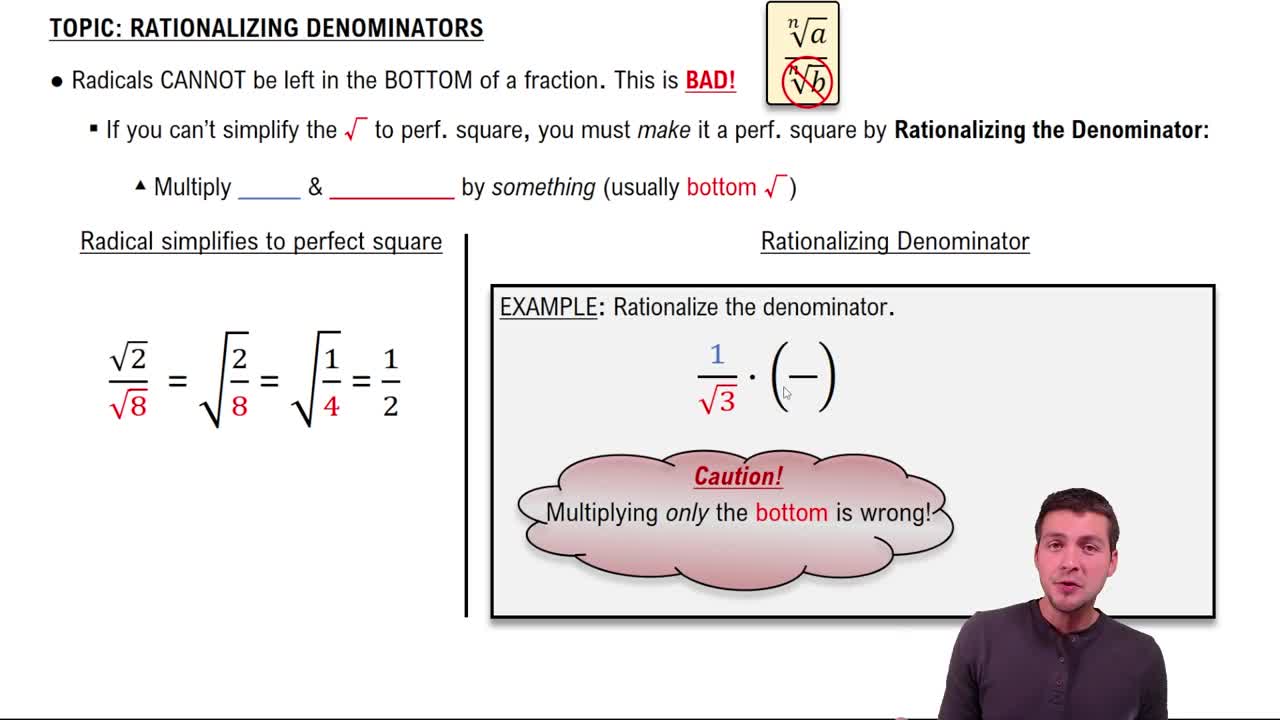
Rationalizing Denominators
Factors of Integers
To apply the Rational Zero Theorem, you must find all factors of the constant term and the leading coefficient. Factors are integers that divide the number without leaving a remainder, and these factors help generate possible rational zeros by forming fractions p/q.
Recommended video:
Guided course
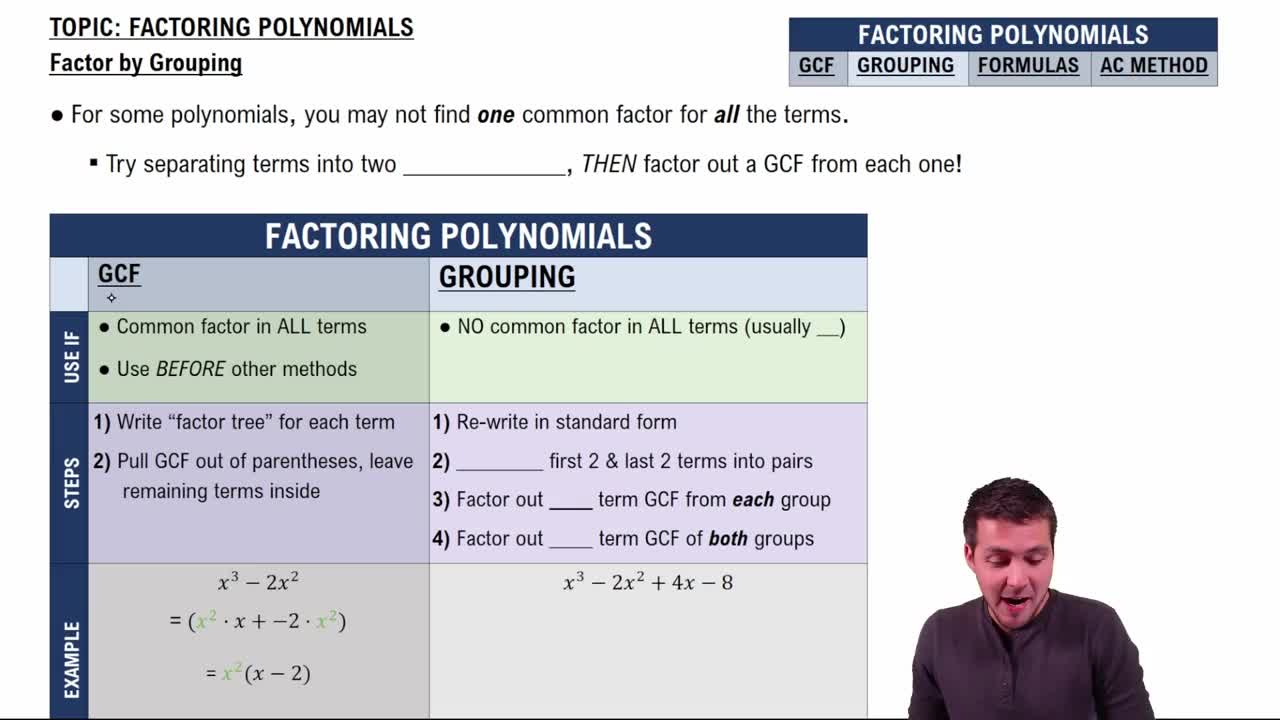
Factor by Grouping
Polynomial Functions and Degree
Understanding the structure of polynomial functions, including the degree and coefficients, is essential. The degree indicates the highest power of x, which affects the number of possible zeros, while coefficients determine the factors used in the Rational Zero Theorem.
Recommended video:
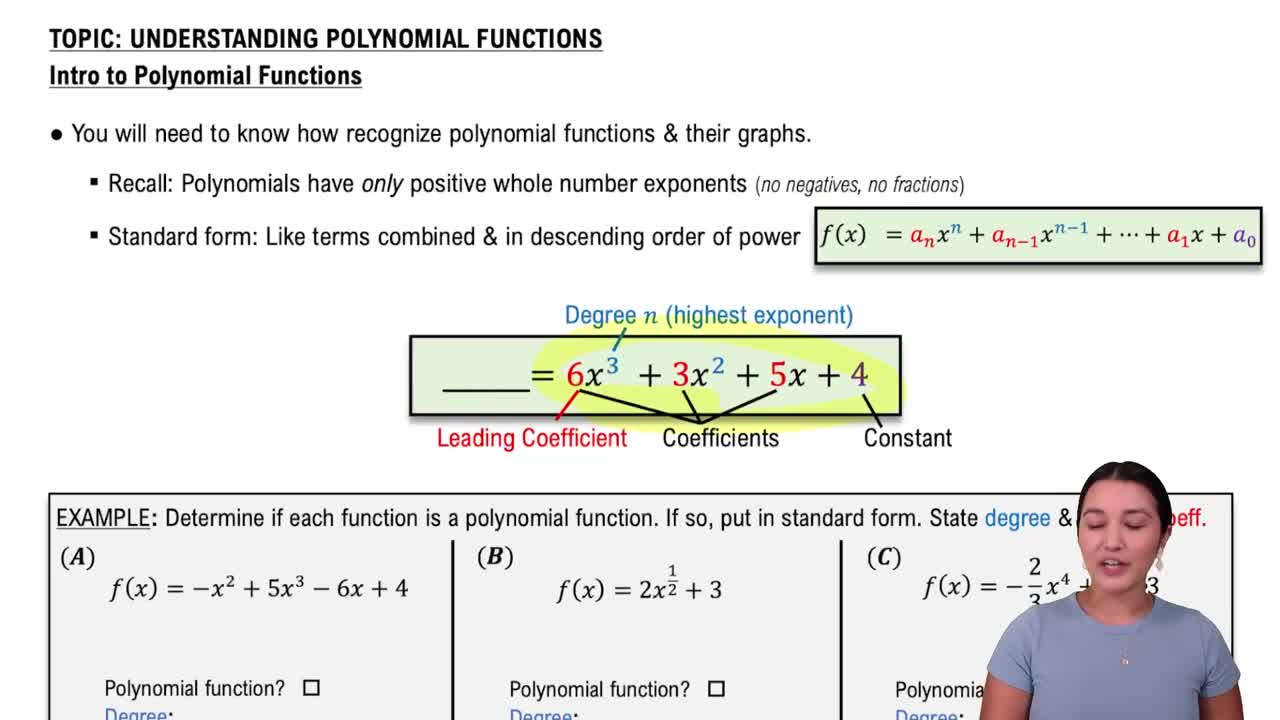
Introduction to Polynomial Functions
Related Practice
Textbook Question
553
views
Textbook Question
Use the four-step procedure for solving variation problems given on page 447 to solve Exercises 1–10. y varies directly as x. y = 65 when x = 5. Find y when x = 12.
172
views
Textbook Question
Determine which functions are polynomial functions. For those that are, identify the degree.
1260
views
Textbook Question
Divide using long division. State the quotient, and the remainder, r(x). (x2+8x+15)÷(x+5)
1275
views
Textbook Question
The graph of a quadratic function is given. Write the function's equation, selecting from the following options.
1526
views
Textbook Question
In Exercises 1–4, use the vertex and intercepts to sketch the graph of each quadratic function. Give the equation for the parabola's axis of symmetry. Use the graph to determine the function's domain and range.
1109
views