In Exercises 1–10, approximate each number using a calculator. Round your answer to three decimal places. 3√5
Ch. 4 - Exponential and Logarithmic Functions

Chapter 5, Problem 1
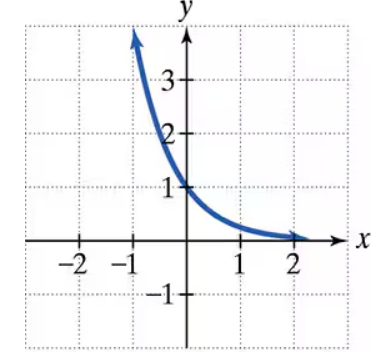
The graph of an exponential function is given. Select the function for each graph from the following options: f(x) = 4x, g(x) = 4-x, h(x) = -4-x, r(x) = -4-x+3

Verified step by step guidance1
Step 1: Identify the point given on the graph, which is (0, 2). This point represents the y-intercept of the function, so when x = 0, y = 2.
Step 2: Evaluate each function option at x = 0 to see which one gives y = 2. Recall that for any base a, a^0 = 1.
Step 3: Calculate f(0) = 4^0 = 1, g(0) = 4^{-0} = 4^0 = 1, h(0) = -4^{-0} = -1, and r(0) = -4^{-0} + 3 = -1 + 3 = 2.
Step 4: Since only r(0) equals 2, the function must be r(x) = -4^{-x} + 3.
Step 5: Confirm the shape of the graph matches the function r(x) = -4^{-x} + 3, which is a reflection and vertical shift of the exponential decay function.

Verified video answer for a similar problem:
This video solution was recommended by our tutors as helpful for the problem above.
Video duration:
4mKey Concepts
Here are the essential concepts you must grasp in order to answer the question correctly.
Exponential Functions and Their Graphs
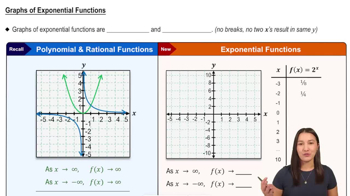
An exponential function has the form f(x) = a^x, where a > 0 and a ≠ 1. Its graph shows rapid growth if a > 1 and decay if 0 < a < 1. The y-intercept is always at (0,1) for f(x) = a^x, since any number to the zero power is 1, unless the function is transformed.
Recommended video:
Graphs of Exponential Functions
Transformations of Exponential Functions
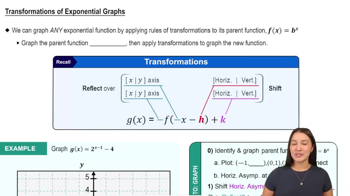
Transformations include reflections, shifts, and stretches. For example, f(x) = 4^-x reflects the graph of 4^x across the y-axis, changing growth to decay. Adding or subtracting constants shifts the graph vertically, affecting the y-intercept and horizontal asymptotes.
Recommended video:
Transformations of Exponential Graphs
Using Points to Identify Functions
Given a point on the graph, such as (0,2), substitute x = 0 into each function to find the corresponding y-value. This helps determine which function matches the graph. For instance, f(0) = a^0 = 1, so if y ≠ 1 at x=0, the function must include vertical shifts or reflections.
Recommended video:
Maximum Turning Points of a Polynomial Function
Related Practice
Textbook Question
812
views
Textbook Question
Solve each exponential equation in Exercises 1–22 by expressing each side as a power of the same base and then equating exponents. 2x=64
595
views
Textbook Question
Use properties of logarithms to expand each logarithmic expression as much as possible. Where possible, evaluate logarithmic expressions without using a calculator. log5 (7 × 3)
928
views
Textbook Question
Use properties of logarithms to expand each logarithmic expression as much as possible. Where possible, evaluate logarithmic expressions without using a calculator. log7 (7x)
921
views
Textbook Question
Solve each exponential equation in Exercises 1–22 by expressing each side as a power of the same base and then equating exponents. 5x=125
708
views
Textbook Question
Write each equation in its equivalent exponential form. 4 = log2 16
1070
views