
Consider the following reaction: 2 NO1g2 + 2 H21g2¡N21g2 + 2 H2O1g2 (d) What is the reaction rate at 1000 K if [NO] is decreased to 0.010 M and 3H24 is increased to 0.030 M?
Consider a hypothetical reaction between A, B, and C that is first order in A, zero order in B, and second order in C. (e) By what factor does the rate change when the concentrations of all three reactants are tripled?
Verified step by step guidance
Verified video answer for a similar problem:
Key Concepts
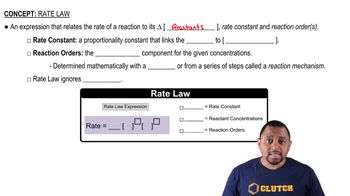
Rate Law
Reaction Order
Effect of Concentration Changes
The decomposition reaction of N2O5 in carbon tetrachloride is 2 N2O5 → 4 NO2 + O2. The rate law is first order in N2O5. At 64°C the rate constant is 4.82 × 10⁻³ s-1. (c) What happens to the rate when the concentration of N2O5 is doubled to 0.0480 M? (d) What happens to the rate when the concentration of N2O5 is halved to 0.0120 M?
A reaction A + B → C obeys the following rate law: Rate = k[B]2. (c) What are the units of the rate constant?
Consider a hypothetical reaction between A, B, and C that is first order in A, zero order in B, and second order in C. (b) How does the rate change when [A] is doubled and the other reactant concentrations are held constant? (c) How does the rate change when [B] is tripled and the other reactant concentrations are held constant? (d) How does the rate change when [C] is tripled and the other reactant concentrations are held constant? (f) By what factor does the rate change when the concentrations of all three reactants are cut in half?
Consider a hypothetical reaction between A, B, and C that is first order in A, zero order in B, and second order in C. (a) Write the rate law for the reaction.
The decomposition reaction of N2O5 in carbon tetrachloride is 2 N2O5 → 4 NO2 + O2. The rate law is first order in N2O5. At 64°C the rate constant is 4.82 × 10⁻³ s-1. (a) Write the rate law for the reaction.
