Hydrogen iodide decomposes slowly to H2 and I2 at 600 K. The reaction is second order in HI, and the rate constant is 9.7 * 10^-6 M^-1 s^-1. Assume the initial concentration of HI is 0.100 M. (a) What is its molarity after a reaction time of 6.00 days?
Verified step by step guidance
1
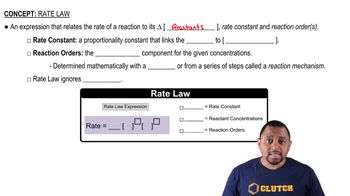
Identify the rate law for a second-order reaction: \( \text{Rate} = k[\text{HI}]^2 \), where \( k \) is the rate constant.
Use the integrated rate law for a second-order reaction: \( \frac{1}{[\text{HI}]} = \frac{1}{[\text{HI}]_0} + kt \), where \([\text{HI}]_0\) is the initial concentration, \([\text{HI}]\) is the concentration at time \( t \), and \( k \) is the rate constant.
Convert the reaction time from days to seconds: \( 6.00 \text{ days} \times 24 \text{ hours/day} \times 3600 \text{ seconds/hour} \).
Substitute the known values into the integrated rate law: \( \frac{1}{[\text{HI}]} = \frac{1}{0.100 \text{ M}} + (9.7 \times 10^{-6} \text{ M}^{-1} \text{ s}^{-1}) \times \text{time in seconds} \).
Solve for \([\text{HI}]\) to find the molarity after 6.00 days.
Key Concepts
Here are the essential concepts you must grasp in order to answer the question correctly.
Second-Order Reactions
A second-order reaction is one where the rate of reaction is proportional to the square of the concentration of one reactant or to the product of the concentrations of two reactants. For a reaction of the form A → products, the rate law can be expressed as rate = k[A]^2. This means that as the concentration of A decreases, the rate of reaction also decreases, which is crucial for calculating concentration changes over time.
The integrated rate law for a second-order reaction provides a relationship between concentration and time. It is given by the equation 1/[A] = 1/[A0] + kt, where [A] is the concentration at time t, [A0] is the initial concentration, k is the rate constant, and t is the time elapsed. This equation allows us to calculate the concentration of a reactant after a specific time period.
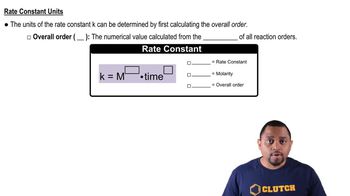
The units of the rate constant (k) are essential for ensuring dimensional consistency in rate equations. For a second-order reaction, the units of k are M^-1 s^-1, indicating that the rate of reaction depends on the concentration squared. Understanding these units helps in correctly applying the integrated rate law and interpreting the results of concentration calculations over time.



 Verified step by step guidance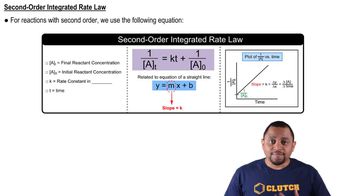
 01:59
01:59