A sample of 37Ar undergoes 8540 disintegrations/min initially but undergoes 6990 disintegrations/min after 10.0 days. What is the half-life of 37Ar in days?
Verified step by step guidance
1
Identify the initial and final disintegration rates: \( R_0 = 8540 \) disintegrations/min and \( R = 6990 \) disintegrations/min after 10 days.
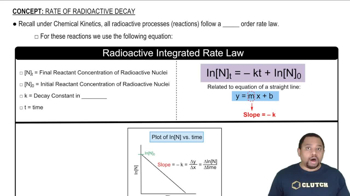
Use the radioactive decay formula: \( R = R_0 \times e^{-\lambda t} \), where \( \lambda \) is the decay constant and \( t \) is the time in days.
Rearrange the formula to solve for \( \lambda \): \( \lambda = \frac{1}{t} \ln\left(\frac{R_0}{R}\right) \).
Substitute the known values into the equation to calculate \( \lambda \): \( \lambda = \frac{1}{10} \ln\left(\frac{8540}{6990}\right) \).
Use the relationship between the decay constant and half-life: \( t_{1/2} = \frac{\ln(2)}{\lambda} \) to find the half-life in days.
Verified video answer for a similar problem:
This video solution was recommended by our tutors as helpful for the problem above.
Video duration:
2m
Play a video:
0 Comments
Was this helpful?
Key Concepts
Here are the essential concepts you must grasp in order to answer the question correctly.
Radioactive Decay
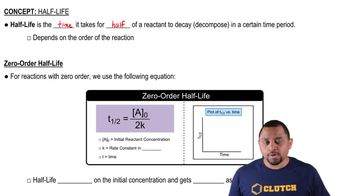
Radioactive decay is the process by which an unstable atomic nucleus loses energy by emitting radiation. This decay occurs at a predictable rate, characterized by the half-life, which is the time required for half of the radioactive nuclei in a sample to decay. Understanding this concept is crucial for analyzing the changes in disintegration rates over time.
Half-life is a specific measure of the time it takes for half of a given quantity of a radioactive substance to decay. It is a constant for each radioactive isotope and is essential for calculating the remaining quantity of the substance after a certain period. In this question, determining the half-life of 37Ar involves using the initial and final disintegration rates over the specified time.
The exponential decay formula describes how the quantity of a radioactive substance decreases over time. It is expressed as N(t) = N0 * (1/2)^(t/T), where N(t) is the quantity at time t, N0 is the initial quantity, and T is the half-life. This formula is fundamental for solving problems related to radioactive decay, as it allows for the calculation of remaining quantities based on time elapsed.



 Verified step by step guidance
 03:00
03:00