Define satellite DNA. Describe where it is found in the genome of eukaryotes and its role as part of chromosomes.
Table of contents
- 1. Introduction to Genetics51m
- 2. Mendel's Laws of Inheritance3h 37m
- 3. Extensions to Mendelian Inheritance2h 41m
- 4. Genetic Mapping and Linkage2h 28m
- 5. Genetics of Bacteria and Viruses1h 21m
- 6. Chromosomal Variation1h 48m
- 7. DNA and Chromosome Structure56m
- 8. DNA Replication1h 10m
- 9. Mitosis and Meiosis1h 34m
- 10. Transcription1h 0m
- 11. Translation58m
- 12. Gene Regulation in Prokaryotes1h 19m
- 13. Gene Regulation in Eukaryotes44m
- 14. Genetic Control of Development44m
- 15. Genomes and Genomics1h 50m
- 16. Transposable Elements47m
- 17. Mutation, Repair, and Recombination1h 6m
- 18. Molecular Genetic Tools19m
- 19. Cancer Genetics29m
- 20. Quantitative Genetics1h 26m
- 21. Population Genetics50m
- 22. Evolutionary Genetics29m
7. DNA and Chromosome Structure
Bacterial and Viral Chromosome Structure
Problem 2
Textbook Question
Write a short essay that contrasts the major differences between the organization of DNA in viruses and bacteria versus eukaryotes.
Verified step by step guidance1
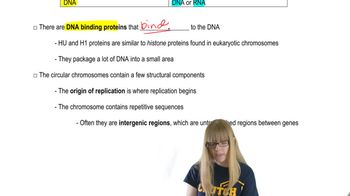
Begin by defining the basic structural organization of DNA in viruses and bacteria, noting that viral genomes can be either DNA or RNA, and when DNA, it is often circular or linear and relatively small in size, while bacterial DNA is typically a single circular chromosome located in the nucleoid region without a membrane-bound nucleus.
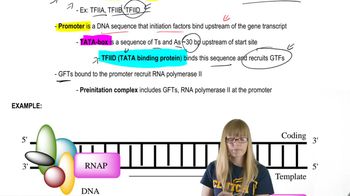
Explain that bacterial DNA is generally not associated with histone proteins but may have other DNA-binding proteins that help compact the DNA, whereas eukaryotic DNA is organized into multiple linear chromosomes tightly wrapped around histone proteins forming nucleosomes, which further fold into higher-order chromatin structures.
Discuss the presence or absence of membrane-bound organelles: bacteria and viruses lack a nucleus, so their DNA is free in the cytoplasm or capsid, while eukaryotic DNA is enclosed within a nuclear membrane, providing compartmentalization and regulation of gene expression.
Highlight the differences in genome size and complexity, with bacterial genomes being smaller and less complex, often containing operons for coordinated gene expression, whereas eukaryotic genomes are larger, contain introns and exons, and have complex regulatory sequences controlling gene expression.
Conclude by mentioning that viral DNA organization varies widely depending on the virus type, sometimes integrating into host genomes or existing as episomes, contrasting with the stable chromosomal organization seen in bacteria and the highly regulated chromatin structure in eukaryotes.
Verified video answer for a similar problem:This video solution was recommended by our tutors as helpful for the problem above
Video duration:
1mPlay a video:
Was this helpful?
Key Concepts
Here are the essential concepts you must grasp in order to answer the question correctly.
DNA Organization in Viruses and Bacteria
Viruses typically have compact genomes made of either DNA or RNA, often single or double-stranded, enclosed within a protein coat, lacking cellular structures. Bacterial DNA is usually a single circular chromosome located in the nucleoid region, with additional plasmids that carry extra genes, and it is not enclosed within a nucleus.
Recommended video:
Guided course
Bacteria and Viral Chromosome Structure
DNA Organization in Eukaryotes
Eukaryotic DNA is organized into multiple linear chromosomes contained within a membrane-bound nucleus. DNA is wrapped around histone proteins forming nucleosomes, which further fold into chromatin, allowing complex regulation of gene expression and efficient packaging within the nucleus.
Recommended video:
Guided course
Eukaryotic Transcription
Differences in Genome Complexity and Packaging
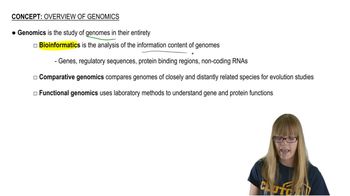
Eukaryotic genomes are generally larger and more complex, with extensive non-coding regions and regulatory sequences, while viral and bacterial genomes are smaller and more streamlined. Eukaryotes use chromatin remodeling and histone modifications for gene regulation, unlike viruses and bacteria, which rely on simpler mechanisms.
Recommended video:
Guided course
Genomics Overview
Watch next
Master Bacteria and Viral Chromosome Structure with a bite sized video explanation from Kylia
Start learningRelated Videos
Related Practice
Textbook Question
45
views