
Textbook Question
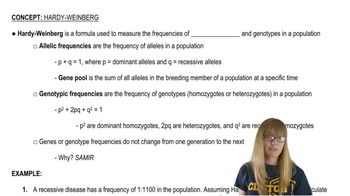
In a population where only the total number of individuals with the dominant phenotype is known, how can you calculate the percentage of carriers and homozygous recessives?
639
views

 Verified step by step guidance
 08:30
08:30
 13:04
13:04 07:56
07:56In a population where only the total number of individuals with the dominant phenotype is known, how can you calculate the percentage of carriers and homozygous recessives?
If 4 percent of a population in equilibrium expresses a recessive trait, what is the probability that the offspring of two individuals who do not express the trait will express it?
Consider rare disorders in a population caused by an autosomal recessive mutation. From the frequencies of the disorder in the population given, calculate the percentage of heterozygous carriers:
0.01
Consider rare disorders in a population caused by an autosomal recessive mutation. From the frequencies of the disorder in the population given, calculate the percentage of heterozygous carriers:
0.10
Consider a population in which the frequency of allele A is p=0.7 and the frequency of allele a is q=0.3 and where the alleles are codominant. What will be the allele frequencies after one generation if the following occurs?
wAA=1, wAa=0.9, waa=0.8
Consider rare disorders in a population caused by an autosomal recessive mutation. From the frequencies of the disorder in the population given, calculate the percentage of heterozygous carriers:
0.09