Ch. 26 - Population and Evolutionary Genetics
Chapter 26, Problem 10a

Consider a population in which the frequency of allele A is p=0.7 and the frequency of allele a is q=0.3 and where the alleles are codominant. What will be the allele frequencies after one generation if the following occurs?
wAA=1, wAa=0.9, waa=0.8

Verified step by step guidance
1
Identify the initial allele frequencies: \(p = 0.7\) for allele A and \(q = 0.3\) for allele a. Since \(p + q = 1\), these represent the starting frequencies before selection.
Calculate the initial genotype frequencies assuming Hardy-Weinberg equilibrium: \(f(AA) = p^2\), \(f(Aa) = 2pq\), and \(f(aa) = q^2\).
Apply the given fitness values to each genotype to find the weighted genotype frequencies after selection: multiply each genotype frequency by its respective fitness, i.e., \(w_{AA} = 1\), \(w_{Aa} = 0.9\), and \(w_{aa} = 0.8\).
Calculate the mean fitness of the population, \(\bar{w}\), by summing the weighted genotype frequencies: \(\bar{w} = f(AA) \times w_{AA} + f(Aa) \times w_{Aa} + f(aa) \times w_{aa}\).
Determine the new allele frequencies after selection by calculating the contribution of each genotype to allele A and allele a, then normalize by dividing by the mean fitness \(\bar{w}\). For allele A, use: \(p' = \frac{f(AA) \times w_{AA} + \frac{1}{2} f(Aa) \times w_{Aa}}{\bar{w}}\). For allele a, use: \(q' = \frac{f(aa) \times w_{aa} + \frac{1}{2} f(Aa) \times w_{Aa}}{\bar{w}}\).

Verified video answer for a similar problem:

This video solution was recommended by our tutors as helpful for the problem above.
Video duration:
57s
Was this helpful?

Key Concepts

Here are the essential concepts you must grasp in order to answer the question correctly.

Allele Frequencies and Hardy-Weinberg Principle

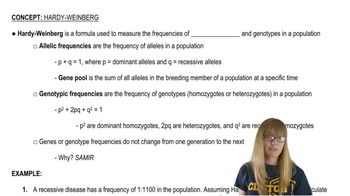
Allele frequencies represent the proportion of different alleles in a population's gene pool. The Hardy-Weinberg principle predicts genotype frequencies from allele frequencies under no evolutionary forces. Understanding initial allele frequencies (p and q) is essential to track changes after selection.
Recommended video:
Guided course
13:04
Hardy Weinberg

Codominance

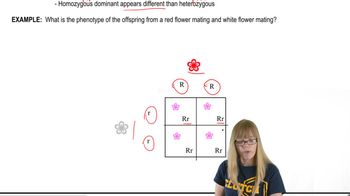
Codominance occurs when both alleles in a heterozygote are fully expressed, producing a distinct phenotype for heterozygotes. This affects how genotypes contribute to fitness and how selection acts on each genotype, influencing allele frequency changes.
Recommended video:
Guided course
04:37
Variations on Dominance

Fitness and Selection Coefficients

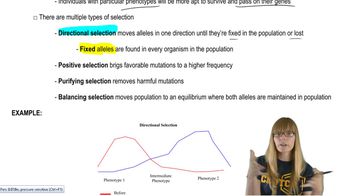
Fitness values (w) measure the reproductive success of genotypes. Selection alters allele frequencies by favoring genotypes with higher fitness. Calculating post-selection allele frequencies requires weighting genotype frequencies by their fitness and normalizing.
Recommended video:
Guided course
05:54
Natural Selection