Pearson+ LogoPearson+ Logo
Ch. 26 - Population and Evolutionary Genetics
Klug - Concepts of Genetics  12th Edition
Klug12th EditionConcepts of Genetics ISBN: 9780135564776Not the one you use?Change textbook
Chapter 26, Problem 9

If 4 percent of a population in equilibrium expresses a recessive trait, what is the probability that the offspring of two individuals who do not express the trait will express it?

Verified step by step guidance
1
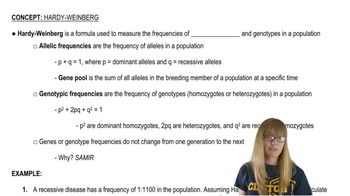
Identify the frequency of the recessive phenotype in the population, which is given as 4%. This means the frequency of the homozygous recessive genotype (q\^2) is 0.04.
Calculate the allele frequency of the recessive allele (q) by taking the square root of q\^2: \(q = \sqrt{0.04}\).
Determine the frequency of the dominant allele (p) using the equation \(p + q = 1\), so \(p = 1 - q\).
Find the genotype frequencies of individuals who do not express the recessive trait. These individuals can be either homozygous dominant (p\^2) or heterozygous carriers (2pq). Calculate these frequencies using \(p\^2\) and \$2pq$.
Calculate the probability that two individuals who do not express the trait (i.e., both are either p\^2 or 2pq) will produce offspring expressing the recessive trait (q\^2). This involves considering all possible mating combinations between non-expressing genotypes and the probability of producing homozygous recessive offspring from each.

Verified video answer for a similar problem:

This video solution was recommended by our tutors as helpful for the problem above.
Video duration:
1m
Was this helpful?

Key Concepts

Here are the essential concepts you must grasp in order to answer the question correctly.

Hardy-Weinberg Equilibrium

This principle states that allele and genotype frequencies in a population remain constant from generation to generation in the absence of evolutionary influences. It provides a mathematical framework to relate allele frequencies to genotype frequencies, allowing calculation of carrier and affected individual proportions.
Recommended video:
Guided course
13:04
Hardy Weinberg

Recessive Trait Expression and Genotype Frequencies

A recessive trait is expressed only when an individual has two copies of the recessive allele (homozygous recessive). The frequency of individuals expressing the trait corresponds to the square of the recessive allele frequency (q²) in the population under Hardy-Weinberg equilibrium.
Recommended video:
Guided course
02:09
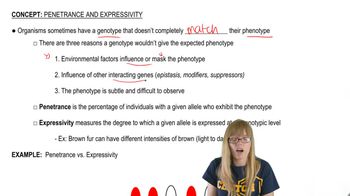
Penetrance and Expressivity

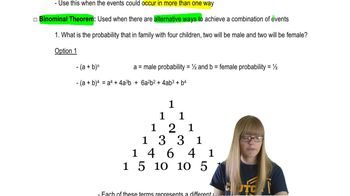
Probability of Offspring Genotypes from Carrier Parents

When two individuals who do not express a recessive trait mate, they may be carriers (heterozygous). The probability that their offspring express the recessive trait depends on the parents' carrier status and follows Mendelian inheritance, typically a 25% chance if both are carriers.
Recommended video: