Describe the cytological observation that suggests that crossing over occurs during the first meiotic prophase.
Ch. 5 - Chromosome Mapping in Eukaryotes

Chapter 5, Problem 6
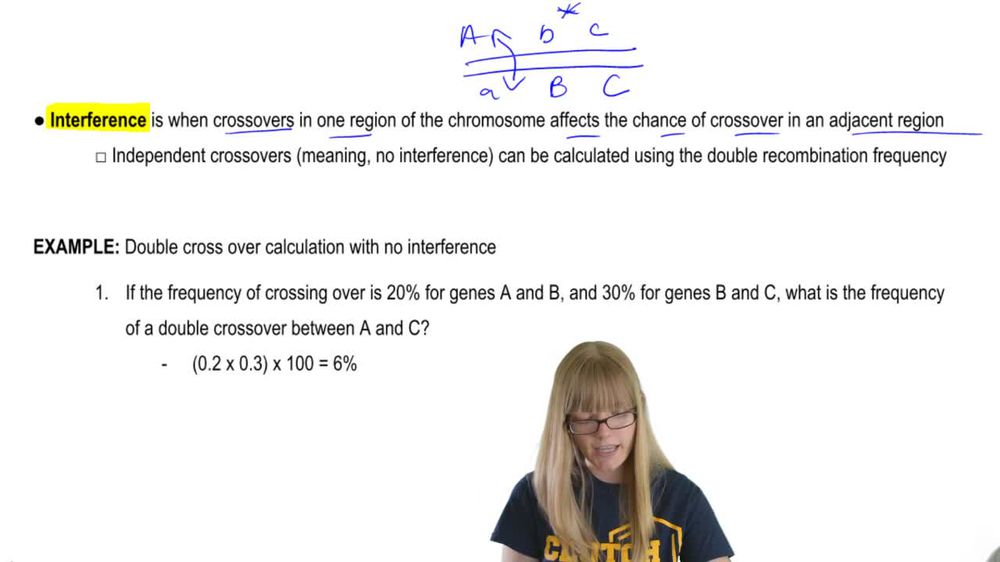
Why are double-crossover events expected less frequently than single-crossover events?
Verified step by step guidance1
Understand that a crossover event during meiosis involves the exchange of genetic material between homologous chromosomes, which can occur at various points along the chromosome.
Recognize that a single-crossover event involves one exchange between chromatids, while a double-crossover event involves two separate exchanges occurring at different locations on the same chromosome.
Recall that the probability of crossover events depends on the physical distance between genes: the farther apart two loci are, the higher the chance of crossover between them.
Since double-crossover events require two independent crossover events to happen on the same chromosome, their probability is the product of the probabilities of each single crossover, making it inherently lower than a single crossover event.
Therefore, double-crossover events are less frequent because they depend on two separate crossover occurrences happening simultaneously, which is statistically less likely than just one crossover event.

Verified video answer for a similar problem:
This video solution was recommended by our tutors as helpful for the problem above.
Video duration:
1mWas this helpful?
Key Concepts
Here are the essential concepts you must grasp in order to answer the question correctly.
Crossing Over
Crossing over is the process during meiosis where homologous chromosomes exchange genetic material. This recombination increases genetic diversity by producing new allele combinations. It typically occurs at specific points called chiasmata along the chromosome.
Recommended video:
Guided course
Discovery of Crossing Over
Single vs. Double Crossover Events
A single crossover involves one exchange between homologous chromosomes, while a double crossover involves two separate exchanges. Double crossovers are less frequent because they require two independent recombination events occurring close together on the same chromosome.
Recommended video:
Guided course
Multiple Cross Overs and Interference
Probability of Recombination Events
The likelihood of crossover events depends on the physical distance between genes; single crossovers are more common because they need only one event. Double crossovers require two events, making their probability the product of two independent crossover probabilities, thus less frequent overall.
Recommended video:
Guided course
Probability
Related Practice
Textbook Question
828
views
Textbook Question
Why does more crossing over occur between two distantly linked genes than between two genes that are very close together on the same chromosome?
832
views
Textbook Question
Explain why a 50 percent recovery of single-crossover products is the upper limit, even when crossing over always occurs between two linked genes?
1032
views
Textbook Question
What is the proposed basis for positive interference?
1051
views
Textbook Question
What two essential criteria must be met in order to execute a successful mapping cross?
681
views
Textbook Question
The genes dumpy (dp), clot (cl), and apterous (ap) are linked on chromosome II of Drosophila. In a series of two-point mapping crosses, the following genetic distances were determined. What is the sequence of the three genes?
dp–ap: 42
dp–cl: 3
ap–cl: 39
947
views