Table of contents
- 1. Introduction to Genetics51m
- 2. Mendel's Laws of Inheritance3h 37m
- 3. Extensions to Mendelian Inheritance2h 41m
- 4. Genetic Mapping and Linkage2h 28m
- 5. Genetics of Bacteria and Viruses1h 21m
- 6. Chromosomal Variation1h 48m
- 7. DNA and Chromosome Structure56m
- 8. DNA Replication1h 10m
- 9. Mitosis and Meiosis1h 34m
- 10. Transcription1h 0m
- 11. Translation58m
- 12. Gene Regulation in Prokaryotes1h 19m
- 13. Gene Regulation in Eukaryotes44m
- 14. Genetic Control of Development44m
- 15. Genomes and Genomics1h 50m
- 16. Transposable Elements47m
- 17. Mutation, Repair, and Recombination1h 6m
- 18. Molecular Genetic Tools19m
- 19. Cancer Genetics29m
- 20. Quantitative Genetics1h 26m
- 21. Population Genetics50m
- 22. Evolutionary Genetics29m
8. DNA Replication
Telomeres and Telomerase
Problem 1d
Textbook Question
In the discussion, we focused on how DNA is organized at the chromosomal level. Along the way, we found many opportunities to consider the methods and reasoning by which much of this information was acquired. From the explanations given in the chapter, what answers would you propose to the following fundamental questions:
How do we know that satellite DNA consists of repetitive sequences and has been derived from regions of the centromere?
Verified step by step guidance1
Step 1: Understand what satellite DNA is — it refers to repetitive DNA sequences that form distinct bands (satellites) when genomic DNA is centrifuged in a density gradient, indicating a different base composition or structure compared to bulk DNA.
Step 2: Review experimental methods such as density gradient centrifugation, which separates DNA based on base composition and reveals the presence of repetitive sequences as distinct satellite bands.
Step 3: Consider DNA hybridization experiments where labeled DNA probes complementary to satellite DNA sequences bind extensively to centromeric regions on chromosomes, showing their physical location.
Step 4: Analyze restriction enzyme digestion patterns and DNA sequencing data that demonstrate the repetitive nature of satellite DNA sequences and their tandem repeat organization.
Step 5: Integrate cytogenetic techniques like fluorescent in situ hybridization (FISH) that visually localize satellite DNA to centromeric regions, confirming their origin and repetitive sequence nature.
Verified video answer for a similar problem:This video solution was recommended by our tutors as helpful for the problem above
Video duration:
49sPlay a video:
Was this helpful?
Key Concepts
Here are the essential concepts you must grasp in order to answer the question correctly.
Satellite DNA and Repetitive Sequences
Satellite DNA refers to tandemly repeated, non-coding DNA sequences that form distinct bands during density gradient centrifugation. These repetitive sequences are often found in heterochromatic regions like centromeres, contributing to chromosome structure and function without coding for proteins.
Recommended video:
Guided course
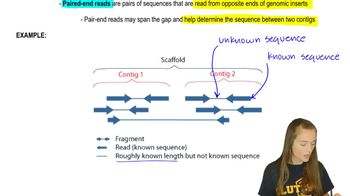
Sequencing Difficulties
Centromere Structure and Function
The centromere is a specialized chromosomal region essential for proper chromosome segregation during cell division. It is rich in repetitive DNA sequences, including satellite DNA, which helps form the kinetochore complex and maintain chromosome stability.
Recommended video:
Guided course
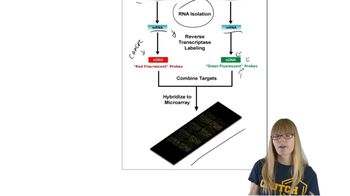
Functional Genomics
Experimental Methods for DNA Characterization
Techniques such as density gradient centrifugation, DNA hybridization, and sequencing allow scientists to identify repetitive DNA and map its chromosomal location. These methods revealed that satellite DNA is abundant in centromeric regions, supporting its derivation from these areas.
Recommended video:
Guided course
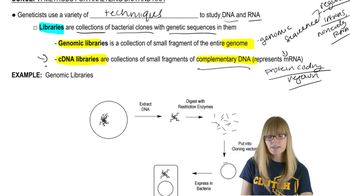
Methods for Analyzing DNA and RNA
Watch next
Master Telomeres and Telomerase with a bite sized video explanation from Kylia
Start learningRelated Videos
Related Practice
Multiple Choice
The function of telomeres is to ______.
28
views