Ch. 12 - DNA Organization in Chromosomes
Klug - Concepts of Genetics  12th Edition
Klug12th EditionConcepts of Genetics ISBN: 9780135564776Not the one you use?Change textbook
Chapter 12, Problem 1a

How do we know that viral and bacterial chromosomes most often consist of circular DNA molecules devoid of protein?

Verified step by step guidance
1
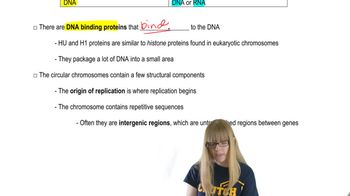
Understand the structural differences between viral, bacterial, and eukaryotic chromosomes. Eukaryotic chromosomes are linear and associated with histone proteins, while many viral and bacterial chromosomes are circular and lack histones.
Review experimental evidence from electron microscopy and molecular biology techniques that visualize DNA molecules. These studies show that bacterial and many viral DNAs form closed loops, indicating circular structure.
Examine biochemical analyses that detect the presence or absence of histone proteins. Bacterial and viral DNAs typically do not have histones, unlike eukaryotic DNA, which is tightly bound to histones forming chromatin.
Consider the functional implications: circular DNA molecules in bacteria and viruses allow for efficient replication and stability without the need for histone packaging, which is essential in eukaryotes due to their larger genome size.
Summarize that the combination of microscopy, protein analysis, and functional studies supports the conclusion that viral and bacterial chromosomes are mostly circular DNA molecules devoid of protein.

Verified video answer for a similar problem:

This video solution was recommended by our tutors as helpful for the problem above.
Video duration:
3m
Was this helpful?

Key Concepts

Here are the essential concepts you must grasp in order to answer the question correctly.

Structure of Viral and Bacterial Chromosomes

Viral and bacterial chromosomes typically consist of circular DNA molecules, unlike the linear chromosomes found in eukaryotes. This circular form helps protect the DNA from degradation and allows efficient replication. Understanding this structural difference is key to studying prokaryotic genetics.
Recommended video:
Guided course
02:39
Bacteria and Viral Chromosome Structure

DNA-Protein Association in Chromosomes

Unlike eukaryotic chromosomes, which are tightly packed with histone proteins, bacterial and viral chromosomes generally lack these proteins. This absence means their DNA is less condensed and more accessible, which influences gene expression and replication mechanisms.
Recommended video:

Experimental Evidence for DNA Structure

Techniques such as electron microscopy, DNA isolation, and biochemical assays have shown that bacterial and viral DNA is circular and mostly free of proteins. These methods reveal the physical form and composition of chromosomes, providing direct evidence for their structure.
Recommended video:
Guided course
06:25
DNA Structure