
Textbook Question
The diagram of a eukaryotic ribosome shown below contains several errors.
Redraw the diagram, and correct each error using the mRNA sequence shown.
462
views

 Verified step by step guidance
 03:13
03:13
The diagram of a eukaryotic ribosome shown below contains several errors.
Redraw the diagram, and correct each error using the mRNA sequence shown.
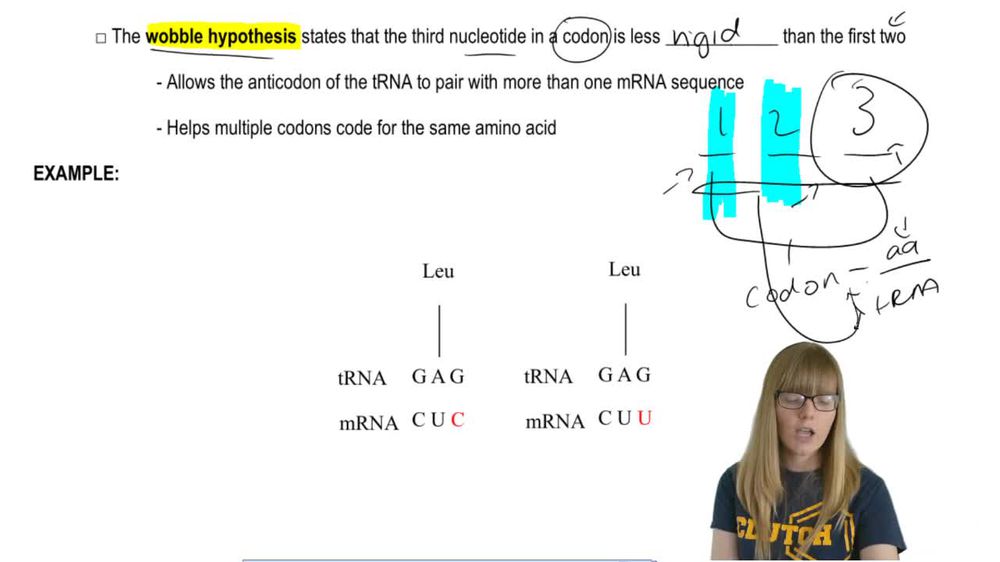
Third-base wobble allows some tRNAs to recognize more than one mRNA codon. Based on this chapter's discussion of wobble, what is the minimal number of tRNA molecules necessary to recognize the following amino acids?
Leucine
Third-base wobble allows some tRNAs to recognize more than one mRNA codon. Based on this chapter's discussion of wobble, what is the minimal number of tRNA molecules necessary to recognize the following amino acids?
Arginine
Third-base wobble allows some tRNAs to recognize more than one mRNA codon. Based on this chapter's discussion of wobble, what is the minimal number of tRNA molecules necessary to recognize the following amino acids?
Lysine
The genetic code contains 61 codons to specify the 20 common amino acids. Many organisms carry fewer than 61 different tRNA genes in their genomes. These genomes take advantage of isoaccepting tRNAs and the rules governing third-base wobble to encode fewer than 61 tRNA genes. Use these rules to calculate the minimal number of tRNA genes required to specify all 20 of the common amino acids.
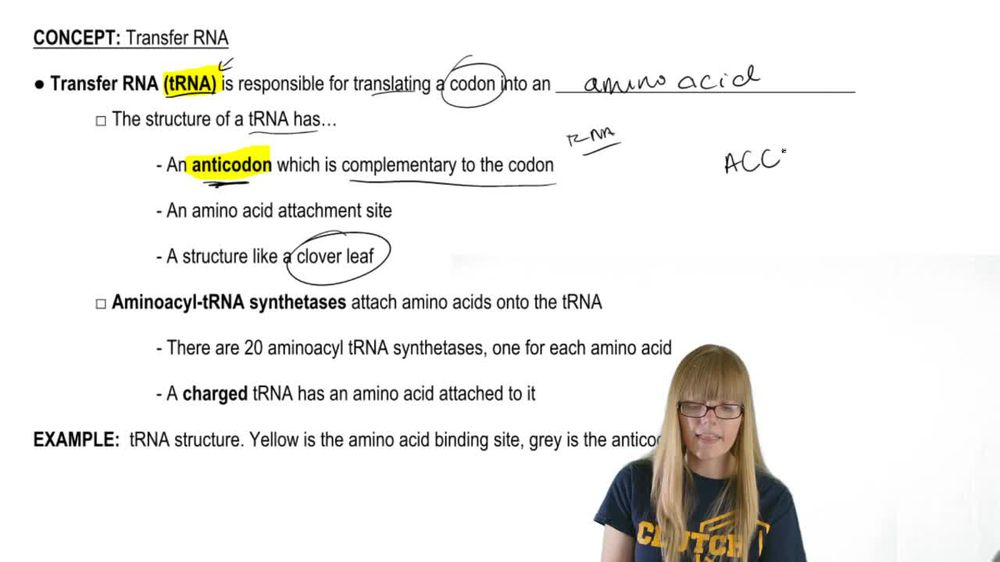
The three major forms of RNA (mRNA, tRNA, and rRNA) interact during translation.
Describe the role each form of RNA performs during translation.