Pearson+ LogoPearson+ Logo
Ch. 16 - Genomics: Genetics from a Whole-Genome Perspective
Sanders - Genetic Analysis: An Integrated Approach 3rd Edition
Sanders3rd EditionGenetic Analysis: An Integrated ApproachISBN: 9780135564172Not the one you use?Change textbook
Chapter 16, Problem 25

In conducting the study described in Problem 24, you have noted that a set of S. cerevisiae genes are repressed when yeast are grown under high-salt conditions.How might you determine whether this set of genes is regulated by a common transcription factor?

Verified step by step guidance
1
Identify the promoter regions of the genes that are repressed under high-salt conditions. This involves analyzing the DNA sequences upstream of the coding regions of these genes.
Search for common DNA motifs or sequences within these promoter regions. These motifs are potential binding sites for transcription factors.
Use bioinformatics tools or databases to compare the identified motifs with known transcription factor binding sites. This can help identify potential transcription factors that bind to these motifs.
Perform chromatin immunoprecipitation (ChIP) assays to experimentally verify if the identified transcription factor binds to the promoter regions of the genes in vivo under high-salt conditions.
Analyze the expression levels of the genes in yeast strains that have deletions or mutations in the identified transcription factor. If the genes are no longer repressed under high-salt conditions, it suggests that the transcription factor is involved in their regulation.

Verified video answer for a similar problem:

This video solution was recommended by our tutors as helpful for the problem above.
Video duration:
1m
Was this helpful?

Key Concepts

Here are the essential concepts you must grasp in order to answer the question correctly.

Transcription Factors

Transcription factors are proteins that bind to specific DNA sequences to regulate the transcription of genes. They can act as activators or repressors, influencing the expression of target genes in response to various signals, such as environmental changes. Understanding the role of transcription factors is crucial for determining how genes are regulated under specific conditions, such as high-salt environments.
Recommended video:
Guided course
09:16
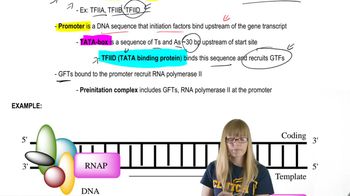
Eukaryotic Transcription

Gene Expression Regulation

Gene expression regulation refers to the mechanisms that control the timing and amount of gene expression. This can involve various processes, including transcriptional regulation by transcription factors, epigenetic modifications, and post-transcriptional mechanisms. Analyzing how gene expression changes in response to high-salt conditions can help identify whether a common transcription factor is involved in regulating the repressed genes.
Recommended video:
Guided course
02:09
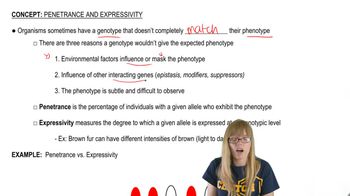
Penetrance and Expressivity

Experimental Techniques for Gene Regulation Analysis

Several experimental techniques can be employed to investigate gene regulation, including chromatin immunoprecipitation (ChIP) assays, which can identify binding sites of transcription factors on DNA, and reporter assays, which measure gene expression in response to specific factors. These methods can help determine if the set of repressed S. cerevisiae genes is regulated by a common transcription factor under high-salt conditions.
Recommended video:
Related Practice
Textbook Question

A substantial fraction of almost every genome sequenced consists of genes that have no known function and that do not have sequence similarity to any genes with known function. How would your approach change if the genes of unknown function were in the human genome?

672
views
Textbook Question

In the globin gene family (shown in the below diagram), which pair of genes would exhibit a higher level of sequence similarity, the human δ-globin and human β-globin genes or the human β-globin and chimpanzee β-globin genes? Can you explain your answer in terms of the timing of gene duplications?

546
views
Textbook Question

You are studying similarities and differences in how organisms respond to high salt concentrations and high temperatures. You begin your investigation by using microarrays to compare gene expression patterns of S. cerevisiae in normal growth conditions, in high salt concentrations, and at high temperatures. The results are shown here, with the values of red and green representing the extent of increase and decrease, respectively, of expression for genes a–s in the experimental conditions versus the control (normal growth) conditions. What is the first step you will take to analyze your data?

379
views
Textbook Question

In conducting the study described in Problem 24, you have noted that a set of S. cerevisiae genes are repressed when yeast are grown under high-salt conditions. How might you approach this question if genome sequences for the related Saccharomyces species S. paradoxus, S. mikatae, and S. bayanus were also available?

402
views
Textbook Question

PEG10 (paternally expressed gene 10) is a paternally expressed gene (meaning only the paternal allele is expressed) that has an essential role in the formation of the placenta of the mouse. In the mouse genome, the PEG10 gene is flanked by the SGCE and PPP1R9A genes. To study the origin of PEG10, you examine syntenic regions spanning the SGCE and PPP1R9A loci in the genomes of several vertebrates, and you note that the PEG10 gene is present in the genomes of placental and marsupial mammals but not in the platypus, chicken, or fugu genomes.

The green bars in the figure indicate the exons of each gene. The gray bars represent LINEs and SINEs, and the blue bars represent long terminal repeat (LTR) elements of retrotransposons. Solid black diagonal lines link introns, and dashed black lines connect orthologous exons. Arrowheads indicate the direction of transcription.

Using the predicted protein sequence of PEG10, you perform a tblastn search for homologous genes and find that the most similar sequences are in a class of retrotransposons (the sushi-ichi retrotransposons). Propose an evolutionary scenario for the origin of the PEG10 gene, and relate its origin to its biological function.

656
views
Textbook Question

What is the difference between biochemical and biological function?

802
views