How was it established experimentally that the frequency of recombination (crossing over) between two genes is related to the distance between them along the chromosome?
Table of contents
- 1. Introduction to Genetics51m
- 2. Mendel's Laws of Inheritance3h 37m
- 3. Extensions to Mendelian Inheritance2h 41m
- 4. Genetic Mapping and Linkage2h 28m
- 5. Genetics of Bacteria and Viruses1h 21m
- 6. Chromosomal Variation1h 48m
- 7. DNA and Chromosome Structure56m
- 8. DNA Replication1h 10m
- 9. Mitosis and Meiosis1h 34m
- 10. Transcription1h 0m
- 11. Translation58m
- 12. Gene Regulation in Prokaryotes1h 19m
- 13. Gene Regulation in Eukaryotes44m
- 14. Genetic Control of Development44m
- 15. Genomes and Genomics1h 50m
- 16. Transposable Elements47m
- 17. Mutation, Repair, and Recombination1h 6m
- 18. Molecular Genetic Tools19m
- 19. Cancer Genetics29m
- 20. Quantitative Genetics1h 26m
- 21. Population Genetics50m
- 22. Evolutionary Genetics29m
4. Genetic Mapping and Linkage
Mapping Overview
Problem 9
Textbook Question
The genes dumpy (dp), clot (cl), and apterous (ap) are linked on chromosome II of Drosophila. In a series of two-point mapping crosses, the following genetic distances were determined. What is the sequence of the three genes?
dp–ap: 42
dp–cl: 3
ap–cl: 39
Verified step by step guidance1
Identify the three genes involved: dumpy (dp), clot (cl), and apterous (ap), and note the given pairwise genetic distances: dp–ap = 42 map units, dp–cl = 3 map units, and ap–cl = 39 map units.
Recall that genetic distances represent the recombination frequency between two genes and that genes that are closer together have smaller distances, indicating tighter linkage.
Start by placing the two genes with the smallest distance on the chromosome, which are dp and cl with 3 map units apart. This suggests dp and cl are very close neighbors.
Next, consider the distances involving ap: dp–ap is 42 and ap–cl is 39. Since dp and cl are close, and ap is far from both, ap must be located on the chromosome such that the distances to dp and cl match the given values.
Arrange the genes in a linear order and verify that the sum of the smaller distances equals the largest distance, i.e., check if the distance between dp and cl plus the distance between cl and ap equals the distance between dp and ap, or if dp is between cl and ap, to determine the correct gene sequence.
Verified video answer for a similar problem:This video solution was recommended by our tutors as helpful for the problem above
Video duration:
51sPlay a video:
Was this helpful?
Key Concepts
Here are the essential concepts you must grasp in order to answer the question correctly.
Genetic Linkage and Gene Mapping
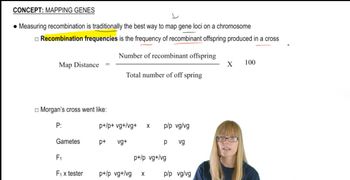
Genetic linkage refers to genes located close together on the same chromosome that tend to be inherited together. Gene mapping uses recombination frequencies between linked genes to estimate their relative positions on a chromosome, measured in map units or centimorgans (cM). Lower recombination frequencies indicate closer proximity.
Recommended video:
Guided course
Mapping Genes
Two-Point Mapping
Two-point mapping involves crossing organisms to measure recombination frequency between two genes at a time. The percentage of recombinant offspring reflects the distance between those genes. By comparing distances from multiple two-point crosses, the relative order of genes can be inferred.
Recommended video:
Guided course
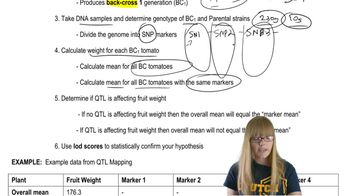
QTL Mapping
Determining Gene Order from Recombination Distances
To determine gene order, compare pairwise distances: the smallest distance indicates the closest genes, and the largest distances help place the third gene relative to the others. The sum of two smaller distances should approximate the largest distance if genes are in a linear sequence.
Recommended video:
Guided course
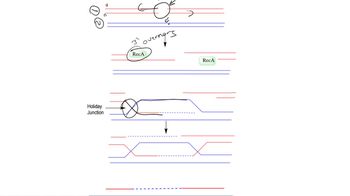
Recombination after Double Strand Breaks
Related Videos
Related Practice
Textbook Question
713
views