Which of the following proteins is responsible for synthesizing RNA primers?
Table of contents
- 1. Introduction to Genetics51m
- 2. Mendel's Laws of Inheritance3h 37m
- 3. Extensions to Mendelian Inheritance2h 41m
- 4. Genetic Mapping and Linkage2h 28m
- 5. Genetics of Bacteria and Viruses1h 21m
- 6. Chromosomal Variation1h 48m
- 7. DNA and Chromosome Structure56m
- 8. DNA Replication1h 10m
- 9. Mitosis and Meiosis1h 34m
- 10. Transcription1h 0m
- 11. Translation58m
- 12. Gene Regulation in Prokaryotes1h 19m
- 13. Gene Regulation in Eukaryotes44m
- 14. Genetic Control of Development44m
- 15. Genomes and Genomics1h 50m
- 16. Transposable Elements47m
- 17. Mutation, Repair, and Recombination1h 6m
- 18. Molecular Genetic Tools19m
- 19. Cancer Genetics29m
- 20. Quantitative Genetics1h 26m
- 21. Population Genetics50m
- 22. Evolutionary Genetics29m
8. DNA Replication
Overview of DNA Replication
Problem 1c
Textbook Question
In the discussion, we focused on how DNA is replicated and synthesized. We also discussed recombination at the DNA level. Along the way, we encountered many opportunities to consider how this information was acquired. On the basis of these discussions, what answers would you propose to the following fundamental questions?
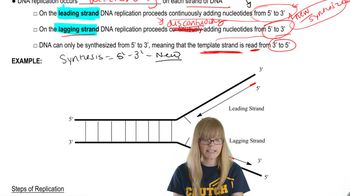
How do we know that in vivo DNA synthesis occurs in the 5' to 3' direction?
Verified step by step guidance1
Recall that DNA polymerases are the enzymes responsible for DNA synthesis during replication, and they add nucleotides to the growing DNA strand.
Understand that DNA polymerases require a free 3'-OH group on the primer strand to add new nucleotides, which means synthesis can only proceed by extending the strand at its 3' end.
Consider experimental evidence such as the use of labeled nucleotides and chain-terminating analogs (e.g., dideoxynucleotides) that show DNA synthesis proceeds by adding nucleotides to the 3' end, confirming the 5' to 3' directionality.
Review classic experiments like those by Arthur Kornberg and others, where the incorporation of nucleotides was measured and shown to occur only in the 5' to 3' direction, as well as the inability of DNA polymerase to add nucleotides in the 3' to 5' direction.
Summarize that the biochemical mechanism of DNA polymerase activity, combined with experimental labeling and termination studies, provides strong evidence that in vivo DNA synthesis occurs in the 5' to 3' direction.
Verified video answer for a similar problem:This video solution was recommended by our tutors as helpful for the problem above
Video duration:
1mPlay a video:
Was this helpful?
Key Concepts
Here are the essential concepts you must grasp in order to answer the question correctly.
Directionality of DNA Synthesis
DNA synthesis occurs in the 5' to 3' direction because DNA polymerases add nucleotides to the free 3' hydroxyl group of the growing strand. This directionality is essential for the enzyme's catalytic mechanism and ensures accurate replication. Experimental evidence, such as incorporation of labeled nucleotides, supports this unidirectional synthesis.
Recommended video:
Guided course
Directionality
Role of DNA Polymerase Enzymes
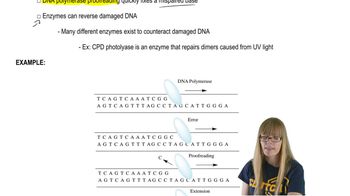
DNA polymerases are enzymes that catalyze the addition of nucleotides during DNA replication. They require a primer with a free 3' OH group and can only add nucleotides in the 5' to 3' direction. Their structure and function explain why DNA synthesis cannot proceed in the opposite direction.
Recommended video:
Guided course
DNA Proofreading
Experimental Evidence for DNA Synthesis Direction
Classic experiments using radiolabeled nucleotides and chain-terminating analogs demonstrated that DNA synthesis proceeds 5' to 3'. For example, pulse-chase experiments and enzymatic assays showed incorporation only at the 3' end, confirming the directionality of DNA replication in vivo.
Recommended video:
Guided course
Directionality
Related Videos
Related Practice
Multiple Choice
807
views
2
rank
