When designed matings cannot be conducted in an organism (for example, in humans), how do we learn that genes are linked, and how do we map them?
Verified step by step guidance
1
Understand the concept of linkage: Linked genes are located close to each other on the same chromosome and tend to be inherited together. This reduces the likelihood of recombination between them during meiosis.
Recognize the importance of pedigree analysis: In humans, where controlled matings are not possible, geneticists use pedigree charts to track inheritance patterns of traits across generations. This helps identify whether certain traits or genes are linked.
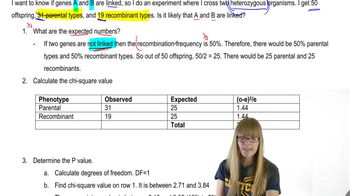
Analyze recombination frequencies: By studying the occurrence of recombination events between linked genes, geneticists can estimate the physical distance between them. Lower recombination frequencies suggest closer proximity on the chromosome.
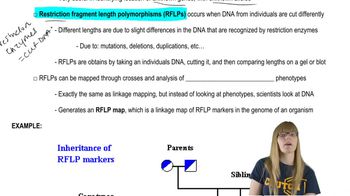
Utilize molecular markers and genome sequencing: Modern techniques, such as SNP (single nucleotide polymorphism) analysis and whole-genome sequencing, allow researchers to identify linked genes and map their locations on chromosomes without requiring controlled matings.
Apply statistical methods: Geneticists use statistical tools, such as LOD (logarithm of odds) scores, to assess the likelihood of linkage between genes based on observed inheritance patterns in families or populations.
Verified video answer for a similar problem:
This video solution was recommended by our tutors as helpful for the problem above
Video duration:
4m
Play a video:
Was this helpful?
Key Concepts
Here are the essential concepts you must grasp in order to answer the question correctly.
Linkage
Linkage refers to the tendency of genes located close to each other on the same chromosome to be inherited together during meiosis. This phenomenon can be observed through genetic crosses and is crucial for understanding inheritance patterns. When genes are linked, the recombination frequency between them is lower than expected, allowing researchers to infer their proximity on the chromosome.
Chromosomal mapping is the process of determining the relative positions of genes on a chromosome. This is often achieved through techniques such as linkage analysis, which uses the frequency of recombination between genes to estimate distances on the chromosome. The resulting genetic maps help in understanding gene interactions and the organization of genetic material.
Genetic markers are specific sequences in the genome that can be used to identify individuals or species and track inheritance patterns. In cases where direct matings cannot be performed, such as in humans, researchers utilize genetic markers to study linkage and map genes. These markers can include single nucleotide polymorphisms (SNPs) or microsatellites, which provide valuable information about genetic relationships and traits.