Pearson+ LogoPearson+ Logo
Ch. 5 - Chromosome Mapping in Eukaryotes
Klug - Concepts of Genetics  12th Edition
Klug12th EditionConcepts of Genetics ISBN: 9780135564776Not the one you use?Change textbook
Chapter 5, Problem 1b

How do we know that specific genes are linked on a single chromosome, in contrast to being located on separate chromosomes?

Verified step by step guidance
1
Understand the concept of genetic linkage: genes that are located close together on the same chromosome tend to be inherited together because they are less likely to be separated by recombination during meiosis.
Perform a test cross or a dihybrid cross involving the two genes in question and observe the offspring phenotypes to determine the frequency of recombinant versus parental types.
Calculate the recombination frequency using the formula: \(\text{Recombination Frequency} = \frac{\text{Number of recombinant offspring}}{\text{Total number of offspring}} \times 100\%\).
Interpret the recombination frequency: if the frequency is significantly less than 50%, it suggests the genes are linked on the same chromosome; if it is close to 50%, the genes assort independently and are likely on different chromosomes.
Confirm linkage by repeating the experiment or using molecular techniques such as chromosome mapping or fluorescence in situ hybridization (FISH) to physically locate the genes on chromosomes.

Verified video answer for a similar problem:

This video solution was recommended by our tutors as helpful for the problem above.
Video duration:
2m
Was this helpful?

Key Concepts

Here are the essential concepts you must grasp in order to answer the question correctly.

Genetic Linkage

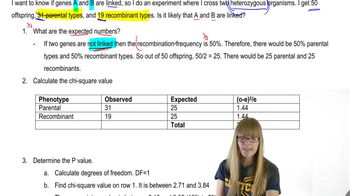
Genetic linkage refers to the tendency of genes located close together on the same chromosome to be inherited together during meiosis. Linked genes do not assort independently, which contrasts with genes on different chromosomes that follow Mendel's law of independent assortment.
Recommended video:
Guided course
07:33
Chi Square and Linkage

Recombination and Crossing Over

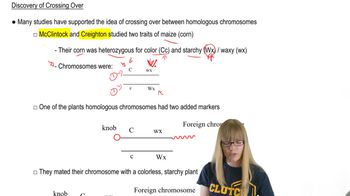
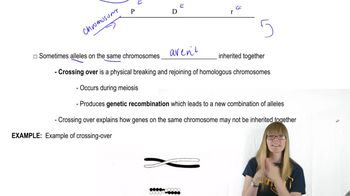
Recombination occurs when homologous chromosomes exchange segments during meiosis, producing new allele combinations. The frequency of recombination between two genes indicates their physical distance on a chromosome; lower recombination rates suggest closer linkage.
Recommended video:
Guided course
05:19
Discovery of Crossing Over

Test Cross and Genetic Mapping

A test cross involves breeding an individual heterozygous for certain genes with a homozygous recessive individual to observe offspring phenotypes. Analyzing offspring ratios helps determine if genes are linked and allows construction of genetic maps based on recombination frequencies.
Recommended video:
Guided course
11:11
Mapping Overview