Which of the following formulas can be used to calculate heterozygote frequency in a population?
Table of contents
- 1. Introduction to Genetics51m
- 2. Mendel's Laws of Inheritance3h 37m
- 3. Extensions to Mendelian Inheritance2h 41m
- 4. Genetic Mapping and Linkage2h 28m
- 5. Genetics of Bacteria and Viruses1h 21m
- 6. Chromosomal Variation1h 48m
- 7. DNA and Chromosome Structure56m
- 8. DNA Replication1h 10m
- 9. Mitosis and Meiosis1h 34m
- 10. Transcription1h 0m
- 11. Translation58m
- 12. Gene Regulation in Prokaryotes1h 19m
- 13. Gene Regulation in Eukaryotes44m
- 14. Genetic Control of Development44m
- 15. Genomes and Genomics1h 50m
- 16. Transposable Elements47m
- 17. Mutation, Repair, and Recombination1h 6m
- 18. Molecular Genetic Tools19m
- 19. Cancer Genetics29m
- 20. Quantitative Genetics1h 26m
- 21. Population Genetics50m
- 22. Evolutionary Genetics29m
21. Population Genetics
Hardy Weinberg
Problem 6e
Textbook Question
Consider rare disorders in a population caused by an autosomal recessive mutation. From the frequencies of the disorder in the population given, calculate the percentage of heterozygous carriers:
0.10
Verified step by step guidance1
Identify the given value as the frequency of individuals affected by the autosomal recessive disorder, which corresponds to the homozygous recessive genotype frequency \(q^{2} = 0.10\).
Calculate the allele frequency of the recessive allele \(q\) by taking the square root of the affected frequency: \(q = \sqrt{q^{2}}\).
Determine the frequency of the dominant allele \(p\) using the relationship \(p + q = 1\), so \(p = 1 - q\).
Calculate the frequency of heterozygous carriers (the carriers) using the formula for heterozygotes in Hardy-Weinberg equilibrium: \$2pq$.
Convert the heterozygous carrier frequency \$2pq$ into a percentage by multiplying by 100 to express the final answer as a percentage of the population.
Verified video answer for a similar problem:This video solution was recommended by our tutors as helpful for the problem above
Video duration:
2mPlay a video:
Was this helpful?
Key Concepts
Here are the essential concepts you must grasp in order to answer the question correctly.
Autosomal Recessive Inheritance
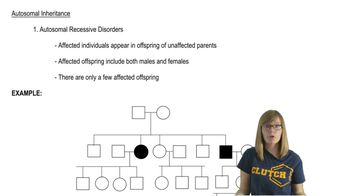
Autosomal recessive disorders require two copies of a mutated gene for the phenotype to appear. Individuals with only one mutated allele are carriers and typically do not show symptoms. Understanding this inheritance pattern is essential to relate genotype frequencies to disease prevalence.
Recommended video:
Guided course
Autosomal Pedigrees
Hardy-Weinberg Equilibrium
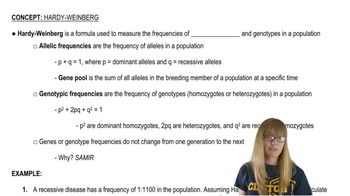
The Hardy-Weinberg principle provides a mathematical framework to relate allele and genotype frequencies in a population under ideal conditions. It allows calculation of carrier frequencies from disease prevalence by using p² + 2pq + q² = 1, where q² represents affected individuals.
Recommended video:
Guided course
Hardy Weinberg
Calculating Carrier Frequency
Carrier frequency (heterozygotes) is calculated as 2pq, where p and q are allele frequencies. Given the disease frequency (q²), one can find q by taking the square root, then p = 1 - q, and finally compute 2pq to find the percentage of carriers in the population.
Recommended video:
Guided course
Calculating Heritability
Related Videos
Related Practice
Multiple Choice
585
views
2
rank