Pearson+ LogoPearson+ Logo
Ch. 9 - The Molecular Biology of Translation
Sanders - Genetic Analysis: An Integrated Approach 3rd Edition
Sanders3rd EditionGenetic Analysis: An Integrated ApproachISBN: 9780135564172Not the one you use?Change textbook
Chapter 9, Problem 2d

In the experiments that deciphered the genetic code, many different synthetic mRNA sequences were tested.
Predict the results of experiments examining GCUA repeats.

Verified step by step guidance
1
Understand the problem: The question involves deciphering the genetic code using synthetic mRNA sequences. The sequence provided is a repeating GCUA. Each codon (group of three nucleotides) in the mRNA sequence corresponds to a specific amino acid based on the genetic code.
Break the repeating sequence into codons: The sequence GCUA repeats, so write it as GCUA GCUA GCUA... and identify the codons. Since codons are groups of three nucleotides, the sequence will produce overlapping codons: GCU, CUA, UAG, and so on.
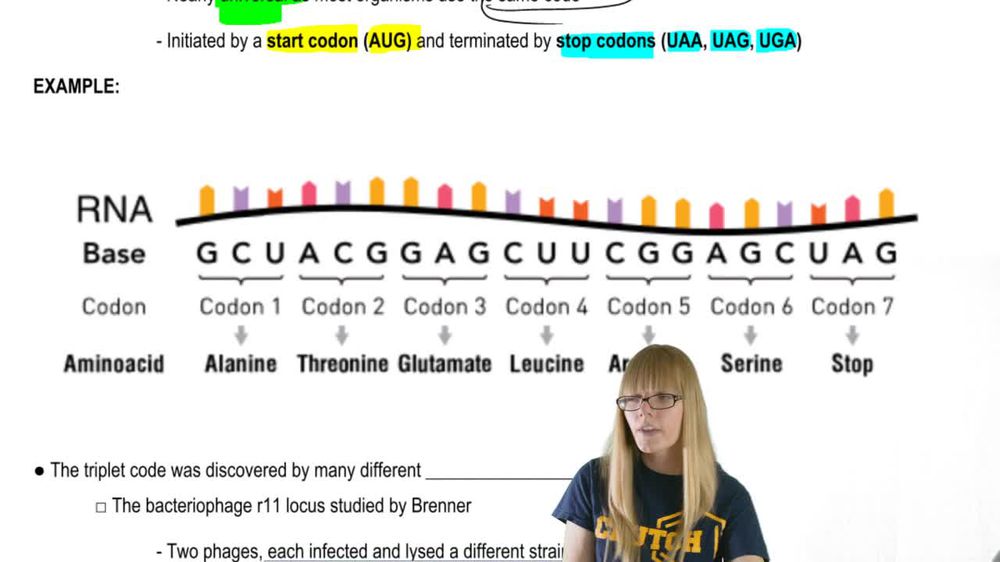
Determine the amino acids for each codon: Use the genetic code table to find the amino acids corresponding to each codon. For example, GCU codes for Alanine (Ala), CUA codes for Leucine (Leu), and UAG is a stop codon.
Predict the results: The presence of a stop codon (UAG) in the sequence will terminate translation. Therefore, the polypeptide produced will depend on where translation starts and will stop when the ribosome encounters the UAG codon.
Summarize the findings: The repeating GCUA sequence will produce short polypeptides that vary depending on the reading frame. Translation will terminate at the UAG stop codon, and the specific amino acids in the polypeptide will depend on the codons read before the stop codon.

Verified video answer for a similar problem:

This video solution was recommended by our tutors as helpful for the problem above.
Video duration:
3m
Was this helpful?

Key Concepts

Here are the essential concepts you must grasp in order to answer the question correctly.

Genetic Code

The genetic code is a set of rules that defines how the sequence of nucleotides in mRNA is translated into amino acids, the building blocks of proteins. It consists of codons, which are triplets of nucleotides, each corresponding to a specific amino acid or a stop signal during protein synthesis. Understanding the genetic code is essential for predicting the outcomes of experiments involving mRNA sequences.
Recommended video:
Guided course
11:43
The Genetic Code

mRNA and Translation

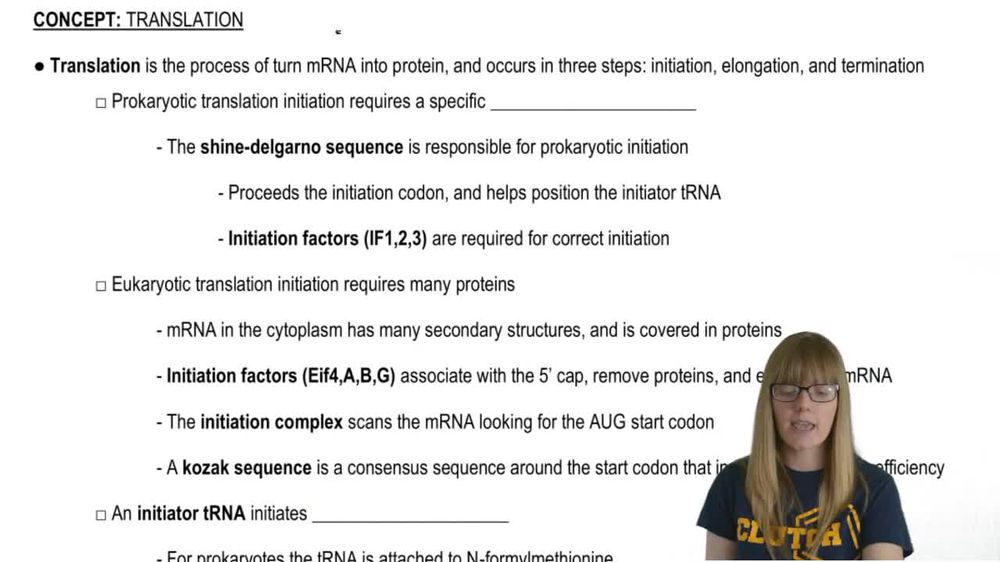
Messenger RNA (mRNA) is a type of RNA that carries genetic information from DNA to the ribosome, where proteins are synthesized. During translation, ribosomes read the mRNA sequence in codons, facilitating the assembly of amino acids into a polypeptide chain. The specific sequence of mRNA, such as GCUA repeats, will influence the resulting protein's structure and function.
Recommended video:
Guided course
07:58
Translation initiation

Repetitive Sequences

Repetitive sequences in mRNA, such as GCUA repeats, can affect the stability and translation efficiency of the mRNA. These sequences may lead to the formation of secondary structures that can hinder or enhance ribosome binding. Understanding how these repeats influence translation is crucial for predicting the results of experiments involving synthetic mRNA.
Recommended video:
Guided course
08:41
Sequencing Difficulties