Considering Problem 15, predict the number of different haploid cells that could be produced by meiosis if a fourth chromosome pair (W1 and W2) were added.
Table of contents
- 1. Introduction to Genetics51m
- 2. Mendel's Laws of Inheritance3h 37m
- 3. Extensions to Mendelian Inheritance2h 41m
- 4. Genetic Mapping and Linkage2h 28m
- 5. Genetics of Bacteria and Viruses1h 21m
- 6. Chromosomal Variation1h 48m
- 7. DNA and Chromosome Structure56m
- 8. DNA Replication1h 10m
- 9. Mitosis and Meiosis1h 34m
- 10. Transcription1h 0m
- 11. Translation58m
- 12. Gene Regulation in Prokaryotes1h 19m
- 13. Gene Regulation in Eukaryotes44m
- 14. Genetic Control of Development44m
- 15. Genomes and Genomics1h 50m
- 16. Transposable Elements47m
- 17. Mutation, Repair, and Recombination1h 6m
- 18. Molecular Genetic Tools19m
- 19. Cancer Genetics29m
- 20. Quantitative Genetics1h 26m
- 21. Population Genetics50m
- 22. Evolutionary Genetics29m
9. Mitosis and Meiosis
Meiosis
Problem 30
Textbook Question
Consider a diploid cell that contains three pairs of chromosomes designated AA, BB, and CC. Each pair contains a maternal and a paternal member (e.g., Am and Ap). Using these designations, demonstrate your understanding of mitosis and meiosis by drawing chromatid combinations as requested. Be sure to indicate when chromatids are paired as a result of replication and/or synapsis.
Assume that each gamete resulting from Problem 29 fuses, in fertilization, with a normal haploid gamete. What combinations will result? What percentage of zygotes will be diploid, containing one paternal and one maternal member of each chromosome pair?
Verified step by step guidance1
First, understand the chromosome setup: the diploid cell has three pairs of chromosomes (AA, BB, CC), each with a maternal (e.g., A^{m}) and paternal (e.g., A^{p}) homolog. Before mitosis or meiosis, each chromosome replicates, forming two sister chromatids per chromosome, which remain attached at the centromere.
For mitosis, illustrate that after replication, each chromosome consists of two identical sister chromatids (e.g., A^{m} with two identical chromatids). During mitosis, sister chromatids separate, so each daughter cell receives one chromatid from each chromosome pair, maintaining the diploid number and identical genetic content.
For meiosis, start by showing synapsis during prophase I, where homologous chromosomes (e.g., A^{m} and A^{p}) pair up tightly, forming tetrads of four chromatids. Crossing over may occur here, exchanging genetic material between non-sister chromatids.
After meiosis I, homologous chromosomes separate into two cells, each still with sister chromatids attached. Then, during meiosis II, sister chromatids separate, resulting in four haploid gametes, each containing one chromatid from each chromosome pair (either maternal or paternal origin, possibly recombinant due to crossing over).
For fertilization, consider that each gamete from meiosis fuses with a normal haploid gamete (with one chromatid from each chromosome). To find the combinations of zygotes, combine the chromatids from both gametes. The percentage of diploid zygotes containing one paternal and one maternal member of each chromosome pair depends on the assortment and recombination events; calculate this by considering independent assortment probabilities and crossing over outcomes.
Verified video answer for a similar problem:This video solution was recommended by our tutors as helpful for the problem above
Video duration:
1mPlay a video:
Was this helpful?
Key Concepts
Here are the essential concepts you must grasp in order to answer the question correctly.
Chromosome Structure and Replication
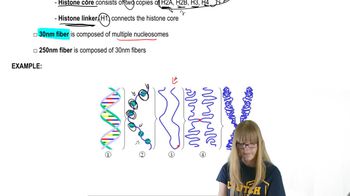
Chromosomes consist of two sister chromatids joined at a centromere after DNA replication. In a diploid cell, each chromosome pair has one maternal and one paternal homolog. Replication doubles chromatids, preparing the cell for division, and is essential for understanding chromatid pairing during mitosis and meiosis.
Recommended video:
Guided course
Chromosome Structure
Mitosis vs. Meiosis
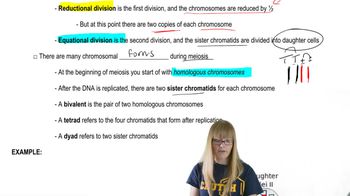
Mitosis produces two genetically identical diploid daughter cells by separating sister chromatids, maintaining chromosome number. Meiosis involves two divisions, reducing chromosome number by half and producing haploid gametes with recombined chromatids due to synapsis and crossing over between homologous chromosomes.
Recommended video:
Guided course
Meiosis Overview
Fertilization and Zygote Formation
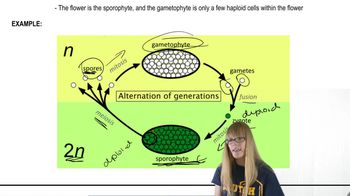
Fertilization fuses two haploid gametes, restoring diploidy in the zygote. The genetic combination depends on the gametes' chromosome composition, including whether chromatids are maternal or paternal. Understanding this helps predict the percentage of zygotes with one maternal and one paternal chromosome from each pair.
Recommended video:
Guided course
Formation of Plant Gametes
Related Videos
Related Practice
Textbook Question
581
views
