Pearson+ LogoPearson+ Logo
Ch. 21 - Genomic Analysis
Klug - Concepts of Genetics  12th Edition
Klug12th EditionConcepts of Genetics ISBN: 9780135564776Not the one you use?Change textbook
Chapter 21, Problem 22b

Homology can be defined as the presence of common structures because of shared ancestry. Homology can involve genes, proteins, or anatomical structures. As a result of 'descent with modification,' many homologous structures have adapted different purposes.
Is it likely that homologous proteins from different species have the same or similar functions? Explain.

Verified step by step guidance
1
Understand the concept of homology: Homology refers to similarities in structures, genes, or proteins due to shared ancestry. These structures may have evolved to serve different purposes in different species.
Consider the evolutionary context: Homologous proteins arise from a common ancestral gene. Over time, mutations and natural selection may lead to divergence in function, but some core aspects of the protein's role may remain conserved.
Analyze functional conservation: Proteins often perform essential biological functions, such as enzymatic activity or structural roles. These functions may be conserved across species, especially if they are critical for survival.
Evaluate divergence in function: While homologous proteins may retain similar functions, they can also adapt to specific needs of the organism. For example, a protein involved in metabolism might have slight variations to suit the energy requirements of different species.
Conclude based on evidence: Homologous proteins are likely to have similar functions due to their shared ancestry, but the degree of similarity depends on the evolutionary pressures and adaptations experienced by each species.

Verified video answer for a similar problem:

This video solution was recommended by our tutors as helpful for the problem above.
Video duration:
2m
Was this helpful?

Key Concepts

Here are the essential concepts you must grasp in order to answer the question correctly.

Homology

Homology refers to the similarity in structure or function between different biological entities due to shared ancestry. This concept is fundamental in evolutionary biology, as it helps scientists understand how species have diverged from common ancestors while retaining certain traits. Homologous structures can be anatomical, genetic, or molecular, indicating evolutionary relationships.
Recommended video:
Guided course
03:51
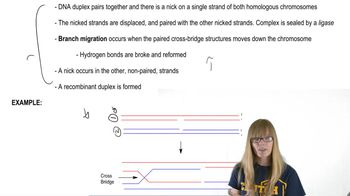
Recombination after Single Strand Breaks

Descent with Modification

Descent with modification is a key principle of evolution that describes how species evolve over time through changes in their genetic makeup. This process leads to the adaptation of traits for different functions in various environments, resulting in homologous structures that may serve different purposes in different species. It highlights the dynamic nature of evolution and the role of natural selection.
Recommended video:
Guided course
04:30
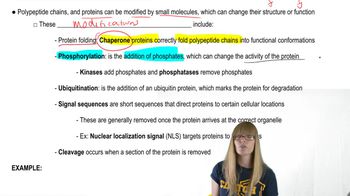
Post Translational Modifications

Protein Function and Evolution

Proteins are essential molecules that perform a wide range of functions in living organisms, and their structure is closely related to their function. While homologous proteins may share a common ancestry, their functions can diverge significantly due to evolutionary pressures and adaptations. Therefore, it is not always likely that homologous proteins from different species will have the same or similar functions, as they may have evolved to fulfill different roles in their respective organisms.
Recommended video:
Related Practice
Textbook Question

An interactive Web site for the Human Proteome Map (HPM) is available at http://www.humanproteomemap.org. Visit this site, and then answer the question.

Use the 'Query' tab and select the 'Gene family' dropdown menu to do a search on the distribution of proteins encoded by a pathway of interest to you. Search in fetal tissues, adult tissues, or both.

536
views
Textbook Question

Researchers have compared candidate loci in humans and rats in search of loci in the human genome that are likely to contribute to the constellation of factors leading to hypertension [Stoll, M., et al. (2000). Genome Res. 10:473–482]. Through this research, they identified 26 chromosomal regions that they consider likely to contain hypertension genes. How can comparative genomics aid in the identification of genes responsible for such a complex human disease? The researchers state that comparisons of rat and human candidate loci to those in the mouse may help validate their studies. Why might this be so?

601
views
Textbook Question

Homology can be defined as the presence of common structures because of shared ancestry. Homology can involve genes, proteins, or anatomical structures. As a result of 'descent with modification,' many homologous structures have adapted different purposes.

List three anatomical structures in vertebrates that are homologous but have different functions.

690
views
Textbook Question

Homology can be defined as the presence of common structures because of shared ancestry. Homology can involve genes, proteins, or anatomical structures. As a result of 'descent with modification,' many homologous structures have adapted different purposes.

Under what circumstances might one expect proteins of similar function to not share homology? Would you expect such proteins to be homologous at the level of DNA sequences?

509
views
Textbook Question

Comparisons between human and chimpanzee genomes indicate that a gene that may function as a wild-type or normal gene in one primate may function as a disease-causing gene in another [The Chimpanzee Sequencing and Analysis Consortium (2005). Nature 437:69–87]. For instance, the PPARG locus (regulator of adipocyte differentiation) is a wild-type allele in chimps but is clearly associated with Type 2 diabetes in humans. What factors might cause this apparent contradiction? Would you consider such apparent contradictions to be rare or common? What impact might such findings have on the use of comparative genomics to identify and design therapies for disease-causing genes in humans?

812
views
Textbook Question

Genomic sequencing has opened the door to numerous studies that help us understand the evolutionary forces shaping the genetic makeup of organisms. Using databases containing the sequences of 25 genomes, scientists examined the relationship between GC content and global amino acid composition [Kreil, D. P., and Ouzounis, C. A. (2001) Nucl. Acids Res. 29:1608–1615]. They found that it is possible to identify thermophilic species on the basis of their amino acid composition alone, which suggests that evolution in a hot environment selects for a certain whole organism amino acid composition. In what way might evolution in extreme environments influence genome and amino acid composition? How might evolution in extreme environments influence the interpretation of genome sequence data?

517
views