Pearson+ LogoPearson+ Logo
Ch. 20 - Recombinant DNA Technology
Klug - Concepts of Genetics  12th Edition
Klug12th EditionConcepts of Genetics ISBN: 9780135564776Not the one you use?Change textbook
Chapter 20, Problem 30

A widely used method for calculating the annealing temperature for a primer used in PCR is 5 degrees below the melting temperature, Tₘ(°C), which is computed by the equation 81.5+0.41×(%GC)−(675/N), where %GC is the percentage of GC nucleotides in the oligonucleotide and N is the length of the oligonucleotide. Notice from the formula that both the GC content and the length of the oligonucleotide are variables. Assuming you have the following oligonucleotide as a primer,
5′-TTGAAAATATTTCCCATTGCC-3′
Compute the annealing temperature for PCR. What is the relationship between %GC and? Why? (Note: In reality, this computation provides only a starting point for empirical determination of the most useful annealing temperature.)
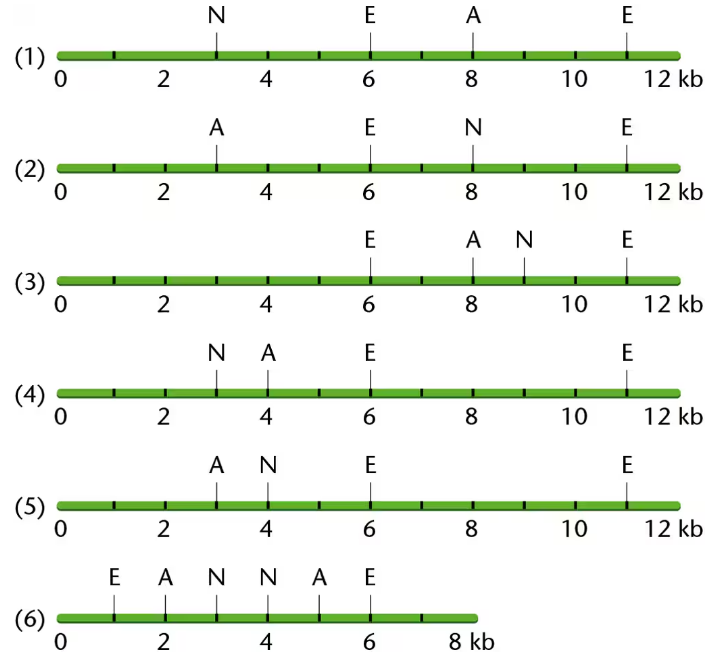
Linear DNA maps showing positions of restriction sites N, E, and A along segments from 0 to 12 kb or 8 kb.

Verified step by step guidance
1
First, determine the length (N) of the oligonucleotide by counting the total number of nucleotides in the sequence 5′-TTGAAAATATTTCCCATTGCC-3′.
Next, calculate the %GC content by counting the number of guanine (G) and cytosine (C) nucleotides in the sequence, then divide by the total length (N) and multiply by 100 to get the percentage.
Use the given formula for melting temperature (Tₘ): Tm°C=81.5+0.41×(%GC)675N to calculate Tₘ by substituting the values of %GC and N.
Calculate the annealing temperature by subtracting 5 degrees Celsius from the melting temperature: Tannealing°C = Tm°C - 5.
Understand the relationship between %GC and melting temperature: higher %GC increases Tₘ because G-C pairs form three hydrogen bonds, making the DNA more stable and harder to denature, whereas A-T pairs have only two hydrogen bonds.

Verified video answer for a similar problem:

This video solution was recommended by our tutors as helpful for the problem above.
Video duration:
1m
Was this helpful?

Key Concepts

Here are the essential concepts you must grasp in order to answer the question correctly.

Melting Temperature (Tₘ) of DNA Primers

The melting temperature (Tₘ) is the temperature at which half of the DNA duplex dissociates into single strands, indicating primer stability. It depends on the primer's nucleotide composition, especially GC content, and length. Accurate Tₘ calculation is crucial for setting the annealing temperature in PCR to ensure specific binding.
Recommended video:
Guided course
11:59
Steps to DNA Replication

GC Content and Its Effect on DNA Stability

GC content refers to the percentage of guanine and cytosine bases in a DNA sequence. GC pairs form three hydrogen bonds, compared to two in AT pairs, making GC-rich regions more thermally stable. Higher %GC increases the melting temperature, influencing primer binding strength during PCR.
Recommended video:
Guided course
03:38
Maternal Effect

Annealing Temperature in PCR

Annealing temperature is the temperature at which primers bind to the target DNA during PCR. It is typically set a few degrees below the primer's Tₘ to promote specific hybridization. Correct annealing temperature balances primer binding efficiency and specificity, affecting PCR success.
Recommended video:
Guided course
07:39
Genetic Cloning
Related Practice
Textbook Question

The CRISPR-Cas system has great potential but also raises many ethical issues about its potential applications because, theoretically, it can be used to edit any gene in the genome. What do you think are some of the concerns about the use of CRISPR-Cas on humans? Should CRISPR-Cas applications be limited for use on only certain human genes but not others? Explain your answers.

680
views
Textbook Question

The gel presented here shows the pattern of bands of fragments produced with several restriction enzymes. The enzymes used are identified above the lanes of the gel, and six possible restriction maps are shown in the column to the right.

One of the six restriction maps shown is consistent with the pattern of bands shown in the gel.

From your analysis of the pattern of bands on the gel, select the correct restriction map and explain your reasoning.

592
views
Textbook Question

The gel presented here shows the pattern of bands of fragments produced with several restriction enzymes. The enzymes used are identified above the lanes of the gel, and six possible restriction maps are shown in the column to the right.

One of the six restriction maps shown is consistent with the pattern of bands shown in the gel.

The highlighted bands (magenta) in the gel were hybridized with a probe for the gene pep during a Southern blot. Where in the gel is the pep gene located? 

794
views
Textbook Question

Most of the techniques (blotting, cloning, PCR, etc.) are dependent on hybridization (annealing) between different populations of nucleic acids. The length of the strands, temperature, and percentage of GC nucleotides weigh considerably on hybridization. Two other components commonly used in hybridization protocols are monovalent ions and formamide. A formula that takes monovalent Na⁺ ions (M[Na⁺]) and formamide concentrations into consideration to compute a Tₘ (temperature of melting) is as follows:

Tₘ=81.5+16.6(log M[Na+])+0.41(%GC)−0.72(%formamide)

For the following concentrations of Na⁺ and formamide, calculate the Tₘ. Assume 45% GC content.

  [Na⁺]  % Formamide

  0.825      20

  0.825      40

  0.165      20

  0.165      40

526
views
Textbook Question

Most of the techniques described in this chapter (blotting, cloning, PCR, etc.) are dependent on hybridization (annealing) between different populations of nucleic acids. The length of the strands, temperature, and percentage of GC nucleotides weigh considerably on hybridization. Two other components commonly used in hybridization protocols are monovalent ions and formamide. A formula that takes monovalent Na⁺ ions (M[Na⁺]) and formamide concentrations into consideration to compute a Tₘ (temperature of melting) is as follows:

Tₘ=81.5+16.6(log M[Na+])+0.41(%GC)−0.72(%formamide)

Given that formamide competes for hydrogen bond locations on nucleic acid bases and monovalent cations are attracted to the negative charges on nucleic acids, explain why the Tₘ varies as described in part (a).

446
views
Textbook Question

In humans, congenital heart disease is a common birth defect that affects approximately 1 out of 125 live births. Using reverse transcription PCR (RT-PCR), Samir Zaidi and colleagues [(2013) Nature 498:220.223] determined that approximately 10 percent of the cases resulted from point mutations, often involving histone function. To capture products of gene expression in developing hearts, they used oligo(dT) in their reverse transcription protocol.

How would such a high %T in a primer influence annealing temperature?

671
views