An organism having the genotype AaBbCcDdEe is self-fertilized. Assuming the five genes assort independently, determine the following proportions:
Progeny that are expected to have a genotype identical to that of the parent.

Verified step by step guidance
An organism having the genotype AaBbCcDdEe is self-fertilized. Assuming the five genes assort independently, determine the following proportions:
Progeny that are expected to have a genotype identical to that of the parent.
An organism having the genotype AaBbCcDdEe is self-fertilized. Assuming the five genes assort independently, determine the following proportions:
Progeny that are expected to have the genotype AabbCcDdE–
An organism having the genotype AaBbCcDdEe is self-fertilized. Assuming the five genes assort independently, determine the following proportions:
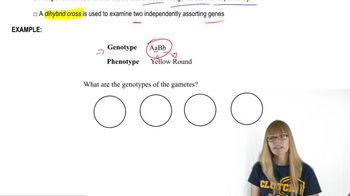
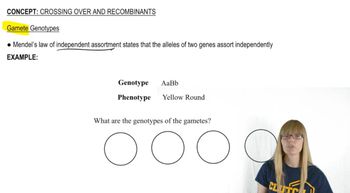
Gametes that are expected to be ABcde.
A man and a woman are each heterozygous carriers of an autosomal recessive mutation of a disorder that is fatal in infancy. They both want to have multiple children, but they are concerned about the risk of the disorder appearing in one or more of their children. In separate calculations, determine the probabilities of the couple having five children with 0, 1, 2, 3, 4, and all 5 children being affected by the disorder.
An organism having the genotype AaBbCcDdEe is self-fertilized. Assuming the five genes assort independently, determine the following proportions:
Gametes that are expected to carry only dominant alleles.
Two parents who are each known to be carriers of an autosomal recessive allele have four children. None of the children has the recessive condition. What is the probability that one or more of the children is a carrier of the recessive allele?