Tay–Sachs disease is an autosomal recessive neurological disorder that is fatal in infancy. Despite its invariably lethal effect, Tay–Sachs disease occurs at very high frequency in some Central and Eastern European (Ashkenazi) Jewish populations. In certain Ashkenazi populations, 1 in 750 infants has Tay–Sachs disease. Population biologists believe the high frequency is a consequence of genetic bottlenecks caused by pogroms (genocide) that have reduced the population multiple times in the past several hundred years. What is a genetic bottleneck?
Table of contents
- 1. Introduction to Genetics51m
- 2. Mendel's Laws of Inheritance3h 37m
- 3. Extensions to Mendelian Inheritance2h 41m
- 4. Genetic Mapping and Linkage2h 28m
- 5. Genetics of Bacteria and Viruses1h 21m
- 6. Chromosomal Variation1h 48m
- 7. DNA and Chromosome Structure56m
- 8. DNA Replication1h 10m
- 9. Mitosis and Meiosis1h 34m
- 10. Transcription1h 0m
- 11. Translation58m
- 12. Gene Regulation in Prokaryotes1h 19m
- 13. Gene Regulation in Eukaryotes44m
- 14. Genetic Control of Development44m
- 15. Genomes and Genomics1h 50m
- 16. Transposable Elements47m
- 17. Mutation, Repair, and Recombination1h 6m
- 18. Molecular Genetic Tools19m
- 19. Cancer Genetics29m
- 20. Quantitative Genetics1h 26m
- 21. Population Genetics50m
- 22. Evolutionary Genetics29m
21. Population Genetics
Allelic Frequency Changes
Problem 26
Textbook Question
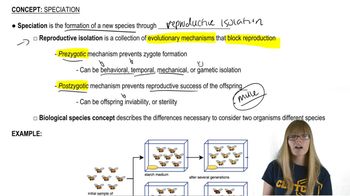
What are the two groups of reproductive isolating mechanisms? Which of these is regarded as more efficient, and why?
Verified step by step guidance1
Identify the two main groups of reproductive isolating mechanisms: prezygotic isolation and postzygotic isolation.
Explain that prezygotic isolation occurs before fertilization and includes mechanisms that prevent mating or fertilization between different species, such as temporal isolation, behavioral isolation, mechanical isolation, and gametic isolation.
Describe postzygotic isolation as mechanisms that occur after fertilization, leading to reduced viability or fertility of the hybrid offspring, such as hybrid inviability, hybrid sterility, and hybrid breakdown.
Discuss why prezygotic isolation is generally regarded as more efficient because it prevents the formation of unfit or sterile hybrids, saving energy and resources that would otherwise be wasted on unsuccessful reproduction.
Summarize that prezygotic mechanisms act earlier in the reproductive process, thus effectively maintaining species boundaries by preventing gene flow before zygote formation.
Verified video answer for a similar problem:This video solution was recommended by our tutors as helpful for the problem above
Video duration:
1mPlay a video:
Was this helpful?
Key Concepts
Here are the essential concepts you must grasp in order to answer the question correctly.
Reproductive Isolating Mechanisms
Reproductive isolating mechanisms are biological features that prevent different species from interbreeding. They maintain species boundaries by reducing gene flow, ensuring species remain distinct. These mechanisms are essential for the process of speciation.
Recommended video:
Guided course
Speciation
Prezygotic Isolation
Prezygotic isolation occurs before fertilization and prevents mating or fertilization between species. Examples include temporal isolation (different mating times), behavioral isolation (different mating behaviors), and mechanical isolation (incompatible reproductive structures).
Recommended video:
Guided course
Speciation
Postzygotic Isolation
Postzygotic isolation happens after fertilization and reduces the viability or fertility of hybrid offspring. Examples include hybrid inviability, hybrid sterility, and hybrid breakdown. It is generally considered less efficient because energy is spent producing unfit hybrids.
Recommended video:
Guided course
Speciation
Related Videos
Related Practice
Textbook Question
772
views