Pearson+ LogoPearson+ Logo
Ch. 10 - DNA Structure and Analysis
Klug - Concepts of Genetics  12th Edition
Klug12th EditionConcepts of Genetics ISBN: 9780135564776Not the one you use?Change textbook
Chapter 10, Problem 32c

Newsdate: March 1, 2030. A unique creature has been discovered during exploration of outer space. Recently, its genetic material has been isolated and analyzed. This material is similar in some ways to DNA in its chemical makeup. It contains in abundance the 4-carbon sugar erythrose and a molar equivalent of phosphate groups. In addition, it contains six nitrogenous bases: adenine (A), guanine (G), thymine (T), cytosine (C), hypoxanthine (H), and xanthine (X). These bases exist in the following relative proportions:
A =T = H and C = G = X
X-ray diffraction studies have established a regularity in the molecule and a constant diameter of about 30 Å. Together, these data have suggested a model for the structure of this molecule.
Given the constant diameter of 30 Å, do you think that either (i) both H and X are purines or both pyrimidines, or (ii) one is a purine and one is a pyrimidine?

Verified step by step guidance
1
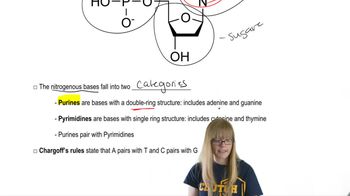
Step 1: Recall the structural difference between purines and pyrimidines. Purines have a two-ring structure and are larger, while pyrimidines have a single-ring structure and are smaller. This size difference affects the diameter of a double-stranded nucleic acid molecule.
Step 2: Understand that in DNA, the constant diameter (~20 Å) is maintained because purines always pair with pyrimidines, ensuring a uniform width. If purines paired with purines or pyrimidines paired with pyrimidines, the diameter would vary due to size differences.
Step 3: Note that the molecule in question has a constant diameter of about 30 Å, which is larger than typical DNA but still constant, suggesting a regular pairing pattern that maintains uniform width.
Step 4: Given the bases A, G, H, and X, and the equal proportions A = T = H and C = G = X, consider the pairing possibilities. Since A and G are purines and T and C are pyrimidines, analyze whether H and X fit better as purines or pyrimidines to maintain a constant diameter.
Step 5: Conclude that to maintain a constant diameter, one of the bases (H or X) should be a purine and the other a pyrimidine, because pairing a purine with a pyrimidine keeps the width uniform, consistent with the observed constant diameter of 30 Å.

Verified video answer for a similar problem:

This video solution was recommended by our tutors as helpful for the problem above.
Video duration:
58s
Was this helpful?

Key Concepts

Here are the essential concepts you must grasp in order to answer the question correctly.

Purines and Pyrimidines Structure

Purines and pyrimidines are the two categories of nitrogenous bases in nucleic acids. Purines (adenine and guanine) have a double-ring structure, while pyrimidines (cytosine, thymine, and uracil) have a single-ring structure. The size difference affects the overall diameter of the nucleic acid helix, as purine-purine pairs are too wide and pyrimidine-pyrimidine pairs are too narrow to maintain a consistent helix diameter.
Recommended video:
Guided course
06:25
DNA Structure

Base Pairing and Complementarity

Base pairing in nucleic acids follows specific rules where purines pair with pyrimidines to maintain a uniform helix diameter. For example, adenine pairs with thymine, and guanine pairs with cytosine. This complementary pairing ensures consistent spacing between strands, which is critical for the stability and regularity of the double helix structure.
Recommended video:
Guided course
05:05
Complementation

X-ray Diffraction and Helix Diameter

X-ray diffraction is a technique used to determine the three-dimensional structure of molecules like DNA. The constant diameter observed (about 20 Å in DNA, 30 Å here) indicates a regular, repeating structure. A uniform diameter suggests that base pairs consist of one purine and one pyrimidine, as purine-purine or pyrimidine-pyrimidine pairs would disrupt this uniformity.
Recommended video:
Guided course
09:30
X-Inactivation
Related Practice
Textbook Question

A primitive eukaryote was discovered that displayed a unique nucleic acid as its genetic material. Analysis provided the following information:

About 75 percent of the sugars are deoxyribose, while 25 percent are ribose.

Postulate a model for the structure of this molecule that is consistent with the foregoing observations.

405
views
Textbook Question

Newsdate: March 1, 2030. A unique creature has been discovered during exploration of outer space. Recently, its genetic material has been isolated and analyzed. This material is similar in some ways to DNA in its chemical makeup. It contains in abundance the 4-carbon sugar erythrose and a molar equivalent of phosphate groups. In addition, it contains six nitrogenous bases: adenine (A), guanine (G), thymine (T), cytosine (C), hypoxanthine (H), and xanthine (X). These bases exist in the following relative proportions:

A =T = H and C = G = X

X-ray diffraction studies have established a regularity in the molecule and a constant diameter of about 30 Å. Together, these data have suggested a model for the structure of this molecule.

Propose a general model of this molecule. Describe it briefly.

541
views
Textbook Question

Newsdate: March 1, 2030. A unique creature has been discovered during exploration of outer space. Recently, its genetic material has been isolated and analyzed. This material is similar in some ways to DNA in its chemical makeup. It contains in abundance the 4-carbon sugar erythrose and a molar equivalent of phosphate groups. In addition, it contains six nitrogenous bases: adenine (A), guanine (G), thymine (T), cytosine (C), hypoxanthine (H), and xanthine (X). These bases exist in the following relative proportions:

A =T = H and C = G = X

X-ray diffraction studies have established a regularity in the molecule and a constant diameter of about 30 Å. Together, these data have suggested a model for the structure of this molecule.

What base-pairing properties must exist for H and for X in the model?

531
views
Textbook Question

During gel electrophoresis, DNA molecules can easily be separated according to size because all DNA molecules have the same charge-to-mass ratio and the same shape (long rod). Would you expect RNA molecules to behave in the same manner as DNA during gel electrophoresis? Why or why not?

822
views
Textbook Question
DNA and RNA are chemically very similar but are distinguished, in large part, by the presence of a 2'-OH group in RNA and a 2'-H group in DNA. Why do you suppose that both DNA and RNA have 3'-OH groups and we do not typically find nucleic acids within cells that have 3'-H groups?
529
views
Textbook Question

Electrophoresis is an extremely useful procedure when applied to analysis of nucleic acids as it can resolve molecules of different sizes with relative ease and accuracy. Large molecules migrate more slowly than small molecules in agarose gels. However, the fact that nucleic acids of the same length may exist in a variety of conformations can often complicate the interpretation of electrophoretic separations. For instance, when a single species of a bacterial plasmid is isolated from cells, the individual plasmids may exist in three forms (depending on the genotype of their host and conditions of isolation): superhelical/supercoiled (form I), nicked/open circle (form II), and linear (form III). Form I is compact and very tightly coiled, with both DNA strands continuous. Form II exists as a loose circle because one of the two DNA strands has been broken, thus releasing the supercoil. All three have the same mass, but each will migrate at a different rate through a gel. Based on your understanding of gel composition and DNA migration, predict the relative rates of migration of the three DNA structures mentioned above.

614
views