Pearson+ LogoPearson+ Logo
Ch. 13 - The Genetic Code and Transcription
Klug - Concepts of Genetics  12th Edition
Klug12th EditionConcepts of Genetics ISBN: 9780135564776Not the one you use?Change textbook
Chapter 13, Problem 3

Assuming the genetic code is a triplet, what effect would the addition or loss of two nucleotides have on the reading frame? The addition or loss of three, six, or nine nucleotides?

Verified step by step guidance
1
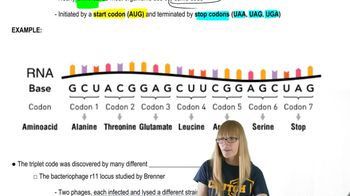
Recall that the genetic code is read in triplets of nucleotides called codons, where each codon corresponds to one amino acid during translation.
Understand that the reading frame is the way nucleotides are grouped into codons, starting from a fixed point and reading three nucleotides at a time.
Consider the effect of adding or losing two nucleotides: since two is not a multiple of three, this will shift the reading frame, causing a frameshift mutation that alters every codon downstream of the mutation.
Consider the effect of adding or losing three, six, or nine nucleotides: since these numbers are multiples of three, the reading frame remains intact, and only the corresponding number of amino acids are added or lost without affecting downstream codons.
Summarize that frameshift mutations occur when the number of nucleotides added or lost is not a multiple of three, while in-frame insertions or deletions (multiples of three) preserve the reading frame.

Verified video answer for a similar problem:

This video solution was recommended by our tutors as helpful for the problem above.
Video duration:
4m
Was this helpful?

Key Concepts

Here are the essential concepts you must grasp in order to answer the question correctly.

Genetic Code and Codons

The genetic code is read in triplets of nucleotides called codons, each specifying a particular amino acid. This triplet nature means that the sequence is divided into non-overlapping groups of three bases during translation, forming the basis for protein synthesis.
Recommended video:
Guided course
11:43
The Genetic Code

Frameshift Mutations

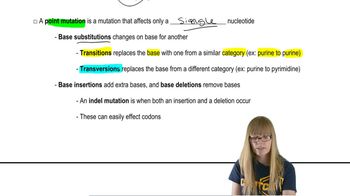
Frameshift mutations occur when nucleotides are inserted or deleted in numbers not divisible by three, disrupting the triplet reading frame. This shifts the grouping of codons downstream, often resulting in completely altered amino acid sequences and nonfunctional proteins.
Recommended video:
Guided course
09:49
Point Mutations

In-frame Insertions and Deletions

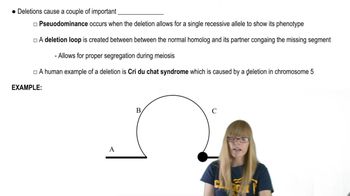
Insertions or deletions of nucleotides in multiples of three do not shift the reading frame but add or remove whole codons. This can lead to the addition or loss of amino acids without altering the downstream sequence, potentially affecting protein function less severely than frameshifts.
Recommended video: