Pearson+ LogoPearson+ Logo
Ch. 13 - The Genetic Code and Transcription
Klug - Concepts of Genetics  12th Edition
Klug12th EditionConcepts of Genetics ISBN: 9780135564776Not the one you use?Change textbook
Chapter 13, Problem 26b

It has been suggested that the present-day triplet genetic code evolved from a doublet code when there were fewer amino acids available for primitive protein synthesis.
The amino acids Ala, Val, Gly, Asp, and Glu are all early members of biosynthetic pathways and are more evolutionarily conserved than other amino acids. They therefore probably represent 'early' amino acids. Of what significance is this information in terms of the evolution of the genetic code? Also, which base, of the first two within a coding triplet, would likely have been the more significant in originally specifying these amino acids?

Verified step by step guidance
1
Understand the concept of the genetic code evolution: The genetic code is a triplet code, meaning that three nucleotide bases specify one amino acid. The hypothesis suggests that the code may have evolved from a simpler doublet code when fewer amino acids were available.
Identify the significance of early amino acids: Ala (Alanine), Val (Valine), Gly (Glycine), Asp (Aspartic acid), and Glu (Glutamic acid) are considered 'early' amino acids because they are evolutionarily conserved and involved in fundamental biosynthetic pathways. This suggests that the primitive genetic code may have been optimized to encode these amino acids first.
Analyze the role of the first two bases in a coding triplet: In a doublet code, only two bases would have been used to specify amino acids. The first two bases of the triplet code are likely to have been more significant in specifying these early amino acids, as they would have carried the primary information in the simpler doublet system.
Consider the evolutionary transition from doublet to triplet code: As more amino acids became available and protein synthesis became more complex, the genetic code likely expanded to include a third base, allowing for greater diversity in amino acid specification.
Reflect on the implications for genetic code evolution: The conservation of early amino acids and the significance of the first two bases in coding suggest that the genetic code evolved in a stepwise manner, starting with a simpler system that gradually increased in complexity to accommodate the growing diversity of amino acids.

Verified video answer for a similar problem:

This video solution was recommended by our tutors as helpful for the problem above.
Video duration:
1m
Was this helpful?

Key Concepts

Here are the essential concepts you must grasp in order to answer the question correctly.

Evolution of the Genetic Code

The genetic code is a set of rules that dictates how sequences of nucleotides in DNA correspond to specific amino acids in proteins. The evolution from a doublet to a triplet code likely allowed for greater specificity and diversity in protein synthesis, accommodating a wider range of amino acids as they became available. Understanding this evolution helps explain how early life forms adapted to their environments and developed more complex biological functions.
Recommended video:
Guided course
11:43
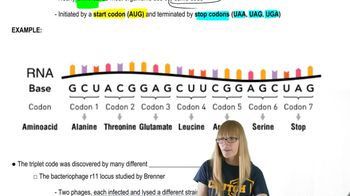
The Genetic Code

Amino Acid Conservation

Amino acid conservation refers to the phenomenon where certain amino acids remain unchanged throughout evolution due to their essential roles in protein structure and function. The early amino acids, such as Ala, Val, Gly, Asp, and Glu, are more conserved because they are fundamental to basic metabolic processes. Their significance in the context of the genetic code's evolution suggests that these amino acids were crucial for the survival of primitive organisms.
Recommended video:
Guided course
09:49
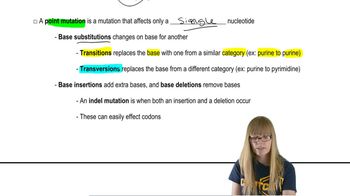
Point Mutations

Significance of Base Position in Codons

In a codon, which is a sequence of three nucleotides, the first two bases are particularly important for determining which amino acid is specified. The first base often has a stronger influence on the identity of the amino acid than the third base, which can sometimes vary without changing the amino acid due to the redundancy in the genetic code. This implies that the first two bases were likely critical in the early stages of codon evolution, especially for specifying the early, conserved amino acids.
Recommended video:
Guided course
07:
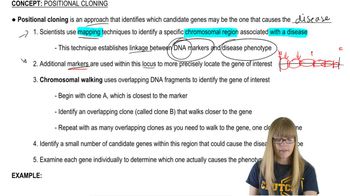
Positional Cloning
Related Practice
Textbook Question

Describe the role of two forms of RNA editing that lead to changes in the size and sequence of pre-mRNAs. Briefly describe several examples of each form of editing, including their impact on respective protein products.

522
views
Textbook Question

Substitution RNA editing is known to involve either C-to-U or A-to-I conversions. What common chemical event accounts for each?

587
views
Textbook Question

It has been suggested that the present-day triplet genetic code evolved from a doublet code when there were fewer amino acids available for primitive protein synthesis.

Can you find any support for the doublet code notion in the existing coding dictionary?

619
views
Textbook Question

It has been suggested that the present-day triplet genetic code evolved from a doublet code when there were fewer amino acids available for primitive protein synthesis.

As determined by comparisons of ancient and recently evolved proteins, cysteine, tyrosine, and phenylalanine appear to be late-arriving amino acids. In addition, they are considered to have been absent in the abiotic Earth. All three of these amino acids have only two codons each, while many others, earlier in origin, have more. Is this mere coincidence, or might there be some underlying explanation?

831
views
Textbook Question

An early proposal by George Gamow in 1954 regarding the genetic code considered the possibility that DNA served directly as the template for polypeptide synthesis. In eukaryotes, what difficulties would such a system pose? What observations and theoretical considerations argue against such a proposal?

590
views
Textbook Question

In a mixed copolymer experiment, messages were created with either 4/5C:1/5A or 4/5A:1/5C. These messages yielded proteins with the following amino acid compositions.

Using these data, predict the most specific coding composition for each amino acid.

926
views