It has been suggested that the present-day triplet genetic code evolved from a doublet code when there were fewer amino acids available for primitive protein synthesis. Can you find any support for the doublet code notion in the existing coding dictionary?
Verified step by step guidance
1
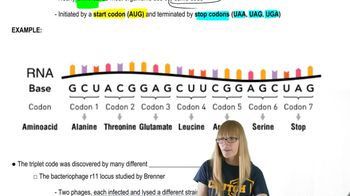
Examine the genetic code table to identify patterns in codon assignments. The genetic code consists of triplet codons, each made up of three nucleotides, which correspond to specific amino acids or stop signals.
Focus on the first two nucleotides of each codon in the table. Analyze whether these two nucleotides alone are sufficient to predict the amino acid or functional group (e.g., hydrophobic, polar, acidic) associated with the codon.
Group codons based on their first two nucleotides and observe if codons with the same first two nucleotides tend to encode similar amino acids or share functional properties. This could suggest a simpler doublet code origin.
Consider the evolutionary implications: If the first two nucleotides of codons show strong predictive power for amino acid assignment, it may indicate that the genetic code initially operated with fewer amino acids and a simpler doublet system before expanding to the triplet code.
Evaluate exceptions and ambiguities in the coding dictionary. Identify codons where the third nucleotide significantly alters the amino acid assignment, as these may represent later evolutionary refinements to the genetic code.
Verified video answer for a similar problem:
This video solution was recommended by our tutors as helpful for the problem above
Video duration:
1m
Play a video:
Was this helpful?
Key Concepts
Here are the essential concepts you must grasp in order to answer the question correctly.
Genetic Code
The genetic code is a set of rules that defines how the sequence of nucleotides in DNA or RNA is translated into the sequence of amino acids in proteins. It is composed of codons, which are triplets of nucleotides. Understanding the genetic code is essential for exploring how proteins are synthesized and how variations in the code can lead to different proteins.
The doublet code refers to a hypothetical early form of the genetic code that utilized pairs of nucleotides (dinucleotides) to encode amino acids, as opposed to the triplet codons used in the modern genetic code. This concept suggests that the genetic coding system may have evolved from simpler forms, which could provide insights into the origins of protein synthesis and the evolution of genetic complexity.
Amino acid availability refers to the presence and abundance of different amino acids in the primordial environment, which would have influenced the early stages of protein synthesis. The hypothesis that the genetic code evolved from a doublet code is supported by the idea that fewer amino acids were available in the early Earth, necessitating a simpler coding system for protein synthesis before the complexity of the triplet code emerged.