Ch. 14 - Translation and Proteins
Klug - Concepts of Genetics  12th Edition
Klug12th EditionConcepts of Genetics ISBN: 9780135564776Not the one you use?Change textbook
Chapter 14, Problem 16

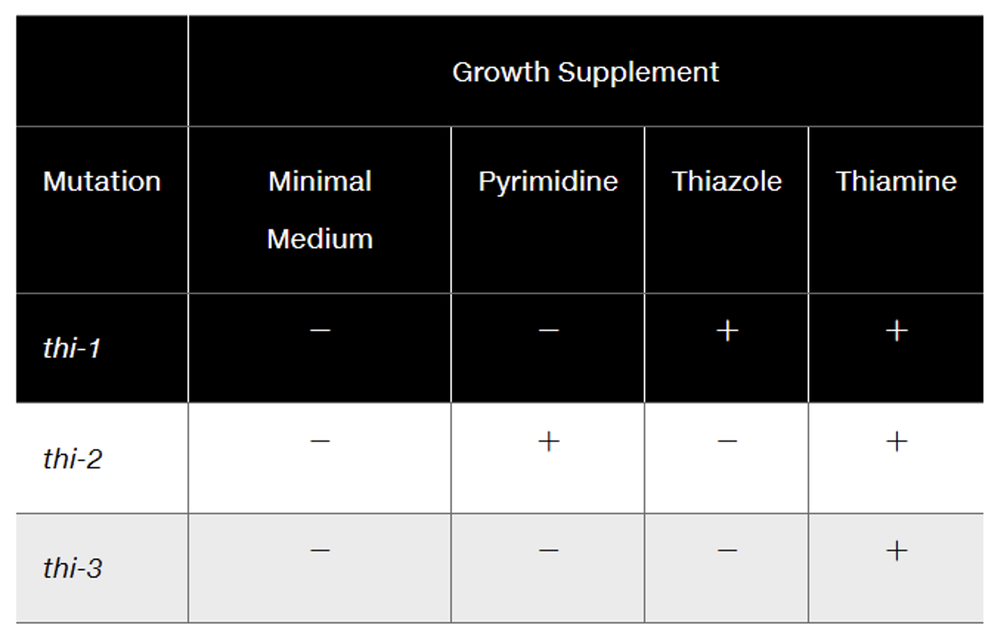
The study of biochemical mutants in organisms such as Neurospora has demonstrated that some pathways are branched. The data shown in the following table illustrate the branched nature of the pathway resulting in the synthesis of thiamine:
Table showing growth of Neurospora mutants on media with supplements, indicating a branched thiamine synthesis pathway.
Why don't the data support a linear pathway? Can you postulate a pathway for the synthesis of thiamine in Neurospora?

Verified step by step guidance
1
Examine the data provided in the table. Note that the growth of the mutants (thi-1, thi-2, and thi-3) is tested on minimal medium, as well as with the addition of pyrimidine, thiazole, and thiamine. Pay attention to which supplements restore growth for each mutant.
Understand the role of each supplement. Pyrimidine and thiazole are precursors or intermediates in the synthesis of thiamine. If a mutant grows when a specific supplement is added, it indicates that the mutation blocks the pathway before the synthesis of that intermediate.
Analyze the growth patterns for each mutant: thi-1 grows only when thiazole or thiamine is added, suggesting a block in the pathway leading to thiazole synthesis. Thi-2 grows only when pyrimidine or thiamine is added, indicating a block in the pathway leading to pyrimidine synthesis. Thi-3 does not grow with pyrimidine or thiazole but grows with thiamine, suggesting a block in the final step of thiamine synthesis.
Determine why the data do not support a linear pathway. In a linear pathway, all mutants would be expected to grow with the addition of a single intermediate downstream of their block. However, the data show that thi-1 and thi-2 require different intermediates (thiazole and pyrimidine, respectively), indicating that the pathway branches into two separate arms leading to the synthesis of these intermediates.
Postulate a branched pathway for thiamine synthesis. Based on the data, propose that the pathway splits into two branches: one branch synthesizes pyrimidine, and the other synthesizes thiazole. These two intermediates are then combined in the final step to produce thiamine. This model explains the growth patterns observed for the mutants.

Verified video answer for a similar problem:

This video solution was recommended by our tutors as helpful for the problem above.
Video duration:
2m
Was this helpful?

Key Concepts

Here are the essential concepts you must grasp in order to answer the question correctly.

Branched Pathways in Metabolism

Branched pathways in metabolism refer to biochemical routes where a single precursor can lead to multiple end products through various enzymatic reactions. In the context of thiamine synthesis, this means that different mutations can affect different branches of the pathway, leading to distinct outcomes in growth depending on the available supplements.
Recommended video:
Guided course
06:28
Branch Diagram

Mutations and Their Effects

Mutations are changes in the DNA sequence that can alter the function of genes, often affecting enzyme production in metabolic pathways. In the case of Neurospora, the mutations (thi-1, thi-2, thi-3) demonstrate how specific genetic changes can disrupt thiamine synthesis, revealing the complexity of metabolic regulation and the necessity of certain intermediates for growth.
Recommended video:
Guided course
03:38
Maternal Effect

Supplementation and Growth Conditions

Supplementation refers to the addition of specific nutrients to a growth medium to support the development of organisms. The data indicates that certain mutants can grow in the presence of specific supplements (like pyrimidine or thiazole), suggesting that these compounds are intermediates in the thiamine synthesis pathway, further supporting the idea of a branched rather than a linear pathway.
Recommended video:
Guided course
04:29
Bacteriophage Life Cycle
Related Practice
Textbook Question
Early detection and adherence to a strict dietary regimen have prevented much of the intellectual disability that used to occur in those with phenylketonuria (PKU). Affected individuals now often lead normal lives and have families. For various reasons, such individuals tend to adhere less rigorously to their diet as they get older. Predict the effect that mothers with PKU who neglect their diets might have on newborns.
495
views
Textbook Question

The synthesis of flower pigments is known to be dependent on enzymatically controlled biosynthetic pathways. For the crosses shown here, postulate the role of mutant genes and their products in producing the observed phenotypes:

P₁: white strain A × white strain B

F₁: all purple

F₂: 9/16purple: 7/16 white

438
views
Textbook Question

The synthesis of flower pigments is known to be dependent on enzymatically controlled biosynthetic pathways. For the crosses shown here, postulate the role of mutant genes and their products in producing the observed phenotypes:

P₁: white × pink

F₁: all purple

F₂: 9/16 purple: 3/16 pink: 4/16 white

422
views
Textbook Question

Explain why the one-gene:one-enzyme concept is not considered totally accurate today.

1087
views
Textbook Question
Why is an alteration of electrophoretic mobility interpreted as a change in the primary structure of the protein under study?
546
views
Textbook Question

Using sickle-cell anemia as an example, describe what is meant by a molecular or genetic disease. What are the similarities and dissimilarities between this type of a disorder and a disease caused by an invading microorganism?

717
views