Pearson+ LogoPearson+ Logo
Ch. 14 - Translation and Proteins
Klug - Concepts of Genetics  12th Edition
Klug12th EditionConcepts of Genetics ISBN: 9780135564776Not the one you use?Change textbook
Chapter 14, Problem 17

Explain why the one-gene:one-enzyme concept is not considered totally accurate today.

Verified step by step guidance
1
Understand the original one-gene:one-enzyme hypothesis, which proposed that each gene encodes a single enzyme responsible for a specific step in a metabolic pathway.
Recognize that later research showed not all proteins are enzymes; some genes encode structural proteins, regulatory proteins, or RNA molecules, which do not function as enzymes.
Learn that some enzymes are made up of multiple polypeptide subunits, each encoded by different genes, meaning one gene does not always correspond to one enzyme.
Consider the discovery of alternative splicing, where a single gene can produce multiple different proteins, challenging the idea of a one-to-one relationship between gene and protein.
Acknowledge that the modern understanding is the one-gene:one-polypeptide concept, which is more accurate but still simplified, as gene expression and protein function are influenced by many factors beyond the gene sequence alone.

Verified video answer for a similar problem:

This video solution was recommended by our tutors as helpful for the problem above.
Video duration:
2m
Was this helpful?

Key Concepts

Here are the essential concepts you must grasp in order to answer the question correctly.

One-Gene:One-Enzyme Hypothesis

This hypothesis, proposed by Beadle and Tatum, states that each gene encodes a single enzyme that affects a specific step in a metabolic pathway. It was foundational in linking genes to biochemical functions but was based on early genetic studies with limited scope.
Recommended video:
Guided course
03:13
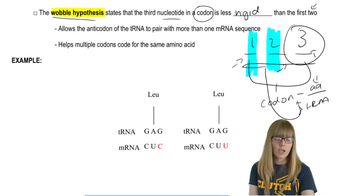
Translation:Wobble Hypothesis

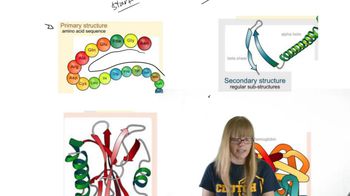
Gene Structure and Protein Complexity

Genes can produce multiple protein products through processes like alternative splicing and post-translational modifications. This means a single gene can give rise to different enzymes or proteins, challenging the idea that one gene corresponds to only one enzyme.
Recommended video:

Non-Enzymatic Gene Products

Not all genes encode enzymes; many genes code for structural proteins, regulatory RNAs, or other functional molecules. This diversity in gene products shows that the one-gene:one-enzyme concept is an oversimplification of gene function.
Recommended video:
Guided course
05:28
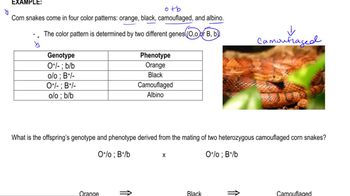
Non-Epistatic Genes
Related Practice
Textbook Question

The synthesis of flower pigments is known to be dependent on enzymatically controlled biosynthetic pathways. For the crosses shown here, postulate the role of mutant genes and their products in producing the observed phenotypes:

P₁: white strain A × white strain B

F₁: all purple

F₂: 9/16purple: 7/16 white

453
views
Textbook Question

The synthesis of flower pigments is known to be dependent on enzymatically controlled biosynthetic pathways. For the crosses shown here, postulate the role of mutant genes and their products in producing the observed phenotypes:

P₁: white × pink

F₁: all purple

F₂: 9/16 purple: 3/16 pink: 4/16 white

431
views
Textbook Question

The study of biochemical mutants in organisms such as Neurospora has demonstrated that some pathways are branched. The data shown in the following table illustrate the branched nature of the pathway resulting in the synthesis of thiamine:

Why don't the data support a linear pathway? Can you postulate a pathway for the synthesis of thiamine in Neurospora?

705
views
Textbook Question
Why is an alteration of electrophoretic mobility interpreted as a change in the primary structure of the protein under study?
559
views
Textbook Question

Using sickle-cell anemia as an example, describe what is meant by a molecular or genetic disease. What are the similarities and dissimilarities between this type of a disorder and a disease caused by an invading microorganism?

745
views
Textbook Question

Contrast the contributions of Pauling and Ingram to our understanding of the genetic basis for sickle-cell anemia.

494
views