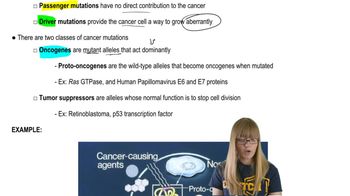
It is estimated that about 0.2 percent of human mutations are due to TE insertions, and a much higher degree of mutational damage is known to occur in some other organisms. In what way might a TE insertion contribute positively to evolution?

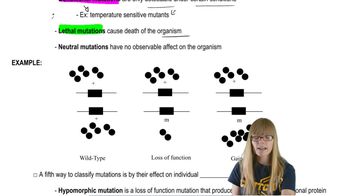
Imagine yourself as one of the team of geneticists who launches a study of the genetic effects of high-energy radiation on the surviving Japanese population immediately following the atom bomb attacks at Hiroshima and Nagasaki in 1945. Demonstrate your insights into both chromosomal and gene mutation by outlining a short-term and long-term study that addresses these radiation effects. Be sure to include strategies for considering the effects on both somatic and germ-line tissues.
Verified step by step guidance
Verified video answer for a similar problem:
Key Concepts
Chromosomal Mutations
Gene Mutations
Somatic vs. Germ-line Effects
In a bacterial culture in which all cells are unable to synthesize leucine (leu⁻), a potent mutagen is added, and the cells are allowed to undergo one round of replication. At that point, samples are taken, a series of dilutions are made, and the cells are plated on either minimal medium or minimal medium containing leucine. The first culture condition (minimal medium) allows the growth of only leu⁺ cells, while the second culture condition (minimal medium with leucine added) allows growth of all cells. The results of the experiment are as follows:
What is the rate of mutation at the locus associated with leucine biosynthesis?
Presented here are hypothetical findings from studies of heterokaryons formed from seven human xeroderma pigmentosum cell strains:
These data are measurements of the occurrence or nonoccurrence of unscheduled DNA synthesis in the fused heterokaryon. None of the strains alone shows any unscheduled DNA synthesis. Which strains fall into the same complementation groups? How many different groups are revealed based on these data? What can we conclude about the genetic basis of XP from these data?
What evidence indicates that mutations in human DNA mismatch repair genes are related to certain forms of cancer?
Among Betazoids in the world of Star Trek®, the ability to read minds is under the control of a gene called mindreader (abbreviated mr). Most Betazoids can read minds, but rare recessive mutations in the mr gene result in two alternative phenotypes: delayed-receivers and insensitives. Delayed-receivers have some mind-reading ability but perform the task much more slowly than normal Betazoids. Insensitives cannot read minds at all. Betazoid genes do not have introns, so the gene only contains coding DNA. It is 3332 nucleotides in length, and Betazoids use a four-letter genetic code.
The following table shows some data from five unrelated mr mutations.
For each mutation, provide a plausible explanation for why it gives rise to its associated phenotype and not to the other phenotype. For example, hypothesize why the mr-1 nonsense mutation in codon 829 gives rise to the milder delayed-receiver phenotype rather than the more severe insensitive phenotype. Then repeat this type of analysis for the other mutations. (More than one explanation is possible, so be creative within plausible bounds!)
